Short answer
You apply for a study authorisation and visa, assessed against Spain’s IPREM income figure. As of 10 October 2026 the IPREM is EUR 600 a month, and a student must show 100 per cent of it for every month of the stay plus the return journey, unless accommodation is already paid for. The current immigration regulation, in force since 20 May 2025, allows up to 30 hours of work a week and limits the long-duration authorisation to higher and post-compulsory secondary education.
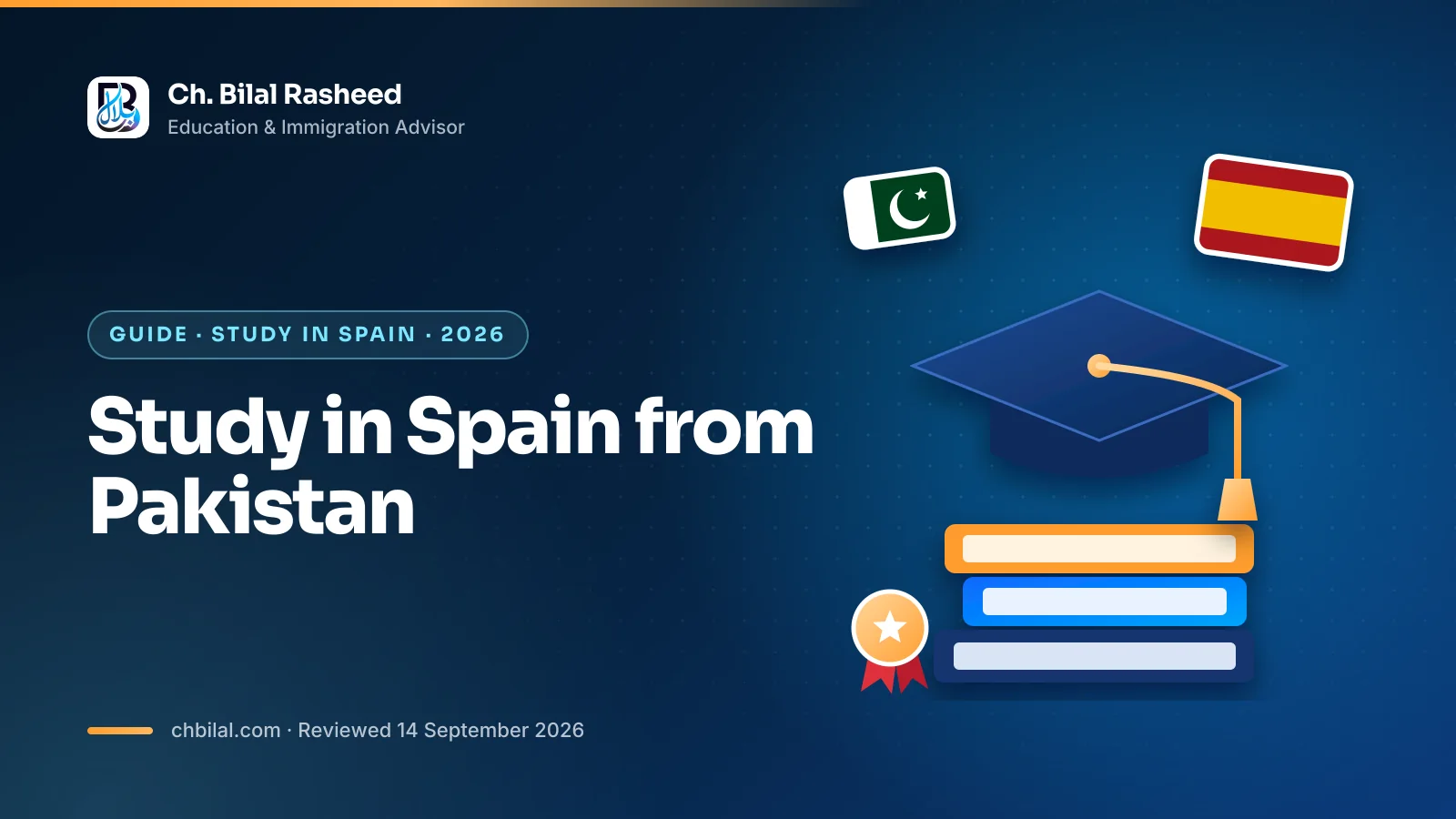
Is Spain a realistic choice from Pakistan?
It can be, and the funds test is the reason. A monthly maintenance requirement of EUR 600 is among the lowest in western Europe, and public university tuition in Spain is modest by comparison with the UK or Ireland. For a family with real but limited savings, Spain is worth looking at properly.
What makes Spain harder than the numbers suggest
Three things, none of them about money. The paperwork chain from Pakistan is long: attestation, legalisation and sworn translation into Spanish. Appointments are a genuine bottleneck. And the 2024 regulation narrowed which courses qualify, so a course that would have worked a few years ago may not now.
The language question, asked honestly
There are English-taught degrees in Spain, particularly at master’s level, but far fewer than in the Netherlands or the Nordics, and the life outside the classroom is in Spanish. A student who arrives with no Spanish will struggle to find the part-time work the thirty-hour rule permits. Plan for that rather than discovering it.
If you are comparing routes, the Italy study guide, the Netherlands study guide and the destination comparison cover the alternatives.
What are you actually applying for?
Spain calls it an authorisation for a stay for studies, estancia por estudios. For a course longer than 90 days you need that authorisation and the visa that lets you enter to take it up. The framework is the immigration regulation approved by Royal Decree 1155/2024, published in the official state gazette on 20 November 2024 and in force since 20 May 2025, which transposes the EU directive on students and researchers.
What the 2024 regulation changed
- It restricted the long-duration study authorisation to higher education and post-compulsory secondary education.
- It set the authorisation up to run for the duration of the studies, rather than requiring a renewal every year.
- It tightened who may later change from studying to residence and work.
- It formalised the expectation that you show tuition paid or registration completed.
The point about duration matters to your budget, because it changes how many months of funds you may be asked to prove at once. Ask the consulate what period it will assess before you decide how much to show, and apply for the full length of the programme rather than a year at a time.
Where the detail lives
Spain publishes an information sheet, a hoja informativa, for this authorisation, and the Secretary of State issued an instruction in 2025 setting out how the new rules are applied. Those two documents, not a blog, are where the current requirements sit. Read the version in force on the day you apply.
Which courses qualify, and which no longer do?
This is the first thing to settle, because the answer decides whether there is an application at all. The regulation limits the long-duration study authorisation to higher education and to post-compulsory secondary education.
The language course trap
Pakistani students are often sold a Spanish language course as a route in. Under the current rules, a language course can be treated as higher education only where it is delivered in person by a higher education institution or centre, and only where it is taught in a language that is neither the student’s mother tongue nor an official language of their country. A general Spanish course at a private academy does not satisfy that.
What to ask the centre, in writing
- Is the centre authorised, and is the programme higher education?
- How many hours a week is it, and is it taught in person?
- What is the total duration, start date and end date?
- What does the acceptance letter say, and will it state the curriculum and duration?
Keep the replies. If a centre will not answer those four questions clearly, that is information too.
How much money do you have to show?
Spain does not publish a student funds figure directly. It publishes a multiple of the IPREM, which is a reference income figure set in the state budget and used across Spanish administration.
The rule, and the number
The requirement for a student is 100 per cent of the monthly IPREM for each month of the stay, together with the cost of returning to your country, unless you can properly prove that accommodation has been paid for the whole period. As of 10 October 2026 the monthly IPREM is EUR 600, which is EUR 7,200 a year in twelve payments, with a daily figure of EUR 20.
| Length of course | Maintenance to show | Plus |
|---|---|---|
| 6 months | EUR 3,600 | The cost of the return journey |
| 9 months | EUR 5,400 | The cost of the return journey |
| 10 months | EUR 6,000 | The cost of the return journey |
| 12 months | EUR 7,200 | The cost of the return journey |
Why the IPREM has not moved
The IPREM has stayed at EUR 600 a month because the 2023 General State Budget was extended rather than replaced, so its figures remain in force. That is a political fact, not a permanent one. When a new budget passes, the IPREM can rise, and the student requirement rises with it. Check the figure in force on the day you apply.
The Supreme Court on the accommodation discount
The Spanish Supreme Court set out the doctrine in a judgment of 20 November 2024: the applicant must guarantee the equivalent of 100 per cent of the monthly IPREM for the stay in Spain and for the return, unless it is duly proved that accommodation costs have been paid in advance, understood broadly. If you intend to rely on prepaid accommodation, you need documentary proof of the payment.
A margin is sensible, a lump deposit is not
Consulates can and do ask to see more than the bare minimum, and they look at how the money got there. A statement showing a single large transfer two weeks before submission invites the question the whole test exists to ask. Ordinary history over several months, in an account the student or a named sponsor controls, is worth more than a bigger number that appeared yesterday.
Where a parent or relative is paying, include their bank evidence and a short letter explaining the relationship and the commitment. The refusal guide sets out how thin money evidence reads from the other side.
The health insurance condition
Spain requires private health insurance taken out with an insurance company authorised to operate in Spain, covering the full period of the stay, with cover comparable to the Spanish public health system.
The two words that get policies rejected
Copago and carencia: co-payment and waiting period. Spanish consulates commonly refuse policies that make the insured pay part of the cost of treatment, or that impose a waiting period before standard treatment is covered. A cheap Pakistani travel policy very often contains both.
What to ask your insurer for
- Written confirmation that the insurer is authorised to operate in Spain.
- A certificate stating that the policy has no co-payment and no waiting period.
- Cover for the full period of the authorisation, not twelve months when the course runs longer.
- Repatriation cover, which several consulates expect to see named.
Buy this once, properly. Replacing a rejected policy after submission costs you an appointment slot you may not get back quickly.
What Pakistani paperwork does Spain require?
More than most. The Spanish chain for Pakistani documents runs through attestation, then legalisation, then sworn translation into Spanish, and each link takes time that cannot be compressed at the end.
The attestation and legalisation chain
- Academic documents attested by the Higher Education Commission for degrees, or the Inter Board Committee of Chairmen for school and intermediate certificates.
- Attestation by the Ministry of Foreign Affairs in Pakistan.
- Legalisation for use in Spain, which is handled through the Embassy’s appointed service provider.
- Translation into Spanish by a sworn translator, after the legalisation, not before.
Older Spanish Embassy checklists for Pakistan asked for original degrees and certificates only, attested by HEC or IBCC, the Ministry of Foreign Affairs and the Embassy. Those checklists are years old now, so treat the chain above as the shape of the process and take the current list from BLS or the Embassy.
The rest of the file
- The completed national visa application form, fully answered.
- Recent passport-size photographs on a white background, following the current specification.
- Passport, with the copies the centre asks for.
- The official letter of acceptance stating the programme, hours and duration, with proof of tuition paid or registration.
- Proof of funds, as set out above.
- The insurance certificate.
- A police character certificate, and a medical certificate where required for the length of stay.
A personal interview may also be required, so be ready to explain your course, your funding and your plan in plain terms.
Applying through BLS International in Pakistan
Spain does not take these submissions at the Embassy counter in Islamabad. They go through BLS International, which operates application centres in Islamabad, Lahore and Karachi. The Embassy still decides; BLS handles the submission.
The appointment is the real constraint
Appointment availability, not processing, is what most often costs a Pakistani applicant an intake. BLS asks for submission at least 15 days before the proposed travel date, and the published general rule is to apply at least two months before the course starts. Neither helps if there is no slot. Start looking as soon as you have an offer.
What BLS charges
As of 10 October 2026 the BLS Pakistan page lists a service charge of PKR 5,209 inclusive of tax, payable in cash, with children under six exempt. That is BLS’s charge for handling the file, and it is separate from the Spanish visa fee.
Fees, and the one figure I could not verify
I will be straight about this rather than fill the gap with a number.
What I could confirm
| Charge | Amount | Status |
|---|---|---|
| Spanish national visa fee for studies | Not verified | The BLS Pakistan page states the visa fee is subject to change without notice; check it on the day |
| BLS International service charge | PKR 5,209 inclusive of tax | Published on the BLS Pakistan page, payable in cash |
| Legalisation and sworn translation | Varies by document count | Quoted per document by the service provider and the translator |
| Agent service charge, if you use one | Varies | Should be itemised in writing, separately from government fees |
Why I have left it blank
The only Pakistan-specific student visa fee I could find in a Spanish Embassy checklist dates from 2016, and quoting a ten-year-old figure would be worse than quoting none. Spanish visa fees for some nationalities are also set on a reciprocal basis, which means they are not safely guessed from another country’s figure. Take the current amount from the BLS Pakistan site or the Embassy’s consular page.
A note on how to read any quote you are given. Government fees, the BLS charge, legalisation, translation and an agent’s own margin are five different things. A single lump sum with no breakdown is a reason to slow down, and the guide to checking a consultant before you pay sets out the registration checks you can run yourself.
When should you start?
Earlier than the official minimums suggest, because the official minimums describe the application and not the Pakistani preparation that comes before it.
A working backwards plan
- Four months out. Start attestation of academic documents. This is the step with the least predictable timeline.
- Three months out. Secure admission and the acceptance letter, and begin looking for a BLS appointment.
- Two to three months out. Legalisation, then sworn translation into Spanish. Buy the insurance.
- At least two months before the course starts. Submit, in line with the published general rule, and at minimum 15 days before travel as BLS requires.
If that plan does not fit the intake you want, the honest answer is the next intake. A rushed Spanish file fails on document form, which is the most avoidable way to lose a year.
Can you work in Spain while you study?
Yes, up to 30 hours a week, provided the work is compatible with your studies. That limit comes from the Spanish regulation and has applied in its current shape since the 2022 reform, carried into the 2024 regulation.
Who needs a separate work authorisation
| Type of study | Weekly limit | Separate work authorisation needed? |
|---|---|---|
| Higher education, including degrees, postgraduate and doctorate | Up to 30 hours | No, the authorisation itself permits work compatible with the studies |
| Other studies, below higher education | Up to 30 hours | Yes, a work authorisation must be applied for, with a signed contract and employer documents |
| Intensive vocational training | As sectoral legislation provides | Check the rule for the specific programme |
The geographic limit nobody mentions
Work on a study authorisation is limited to the autonomous community where your authorisation was granted, with some exceptions for bordering localities. A student authorised in Valencia cannot simply take a job in Madrid. If your plan assumed otherwise, check it before you move.
Thirty hours is a ceiling, not an income plan
I would not fund tuition from this. Spanish part-time work is largely in Spanish, youth unemployment is high in parts of the country, and the authorisation exists for study. A file that quietly depends on work earnings to cover fees is the kind of file that fails, and should.
The TIE card after you arrive
For a stay of more than six months, the visa gets you in and the TIE, the tarjeta de identidad de extranjero, is what proves your status in Spain. You apply for it after arriving.
What that involves
- An appointment at the foreigners’ office or a police station.
- Fingerprints, photographs and a fee.
- Proof of your address in Spain.
- A receipt, the resguardo, which you keep until the card itself is issued.
Deadlines and local practice vary by province, and that is not a detail to take from a guide written in Lahore. Ask your university’s international office in your first week what the deadline is where you are, and book the appointment immediately, because slots go quickly at the start of a semester.
What happens after the degree?
The 2024 regulation narrowed the move from studying to working, and anyone planning that route should know the limits before enrolling rather than after graduating.
Who is excluded from changing status
Article 190.1 of the regulation blocks a change to residence and work for people who have received scholarships funded from public cooperation funds, and for people whose studies were not higher education. There is also transitional treatment for students who were already in Spain under the previous 2011 regulation, which an instruction issued in 2025 addresses.
What I am not going to tell you
Whether your particular case will be allowed to switch. That depends on the current text, your course, your funding source and your timing, and it is the kind of question a Spanish immigration lawyer answers properly. This site covers study, visit and family routes, and it will not dress up a study application as a work route, because the people who do that are the reason so many Pakistani families lose money.
How do you apply, step by step?
The order below front-loads the two things that most often stop a Spanish application: whether the course qualifies, and the Pakistani document chain.
Check your course qualifies for the long-duration study authorisation
The 2024 immigration regulation limits the long-duration study authorisation to higher education and post-compulsory secondary education. A language course only counts as higher education if an authorised higher education institution teaches it in person, in a language that is neither your mother tongue nor an official language of your country. Confirm this before you pay a deposit.
Get admission and pay or register for the tuition
Obtain an official letter of acceptance from the authorised centre, setting out the programme, the hours and the duration. Spanish practice now expects proof that the tuition has been paid or that you are registered, so keep the receipt. Ask the centre to state the full length of the programme, so you can apply for the whole period at once.
Work out your funds against the IPREM and hold them properly
You must show 100 per cent of the monthly IPREM for each month of your stay, plus the cost of returning home, unless you can prove your accommodation is paid for the whole stay. At an IPREM of EUR 600 a month that is EUR 7,200 for a twelve-month course. Keep the money in an account you control, with ordinary history behind it.
Buy private health insurance that meets the Spanish conditions
The insurance must be with an insurer authorised to operate in Spain, and must give cover equivalent to the Spanish public system for the whole stay. Ask the insurer for a certificate stating the cover, and check whether your policy carries co-payments or waiting periods, because consulates commonly reject policies that do.
Attest, legalise and translate your Pakistani documents
Educational documents are attested through HEC or IBCC, then the Ministry of Foreign Affairs, then legalised for Spain. Documents then need translation into Spanish by a sworn translator. This is the longest part of the process from Pakistan, so start it before you have the offer in hand.
Book and submit through BLS International
Submissions for Spain from Pakistan go through BLS International, which runs centres in Islamabad, Lahore and Karachi. Book early, because appointments are the usual bottleneck. Take the originals, the photographs and the fee, and expect a separate BLS service charge on top of the visa fee.
Travel, then apply for the TIE card after you arrive
For a stay of more than six months you apply in Spain for the foreigner identity card, the TIE, after arrival. Register at your local office within the period they set, take your fingerprints appointment seriously, and keep the resguardo until the card is issued.
What goes wrong most often?
Enrolling on a course that does not qualify
The long-duration authorisation is for higher education and post-compulsory secondary education. A general private language course is the classic mis-sale, and the deposit is usually non-refundable by the time anyone checks.
Showing the minimum, deposited last week
Exactly EUR 600 a month, placed in the account a fortnight before submission, answers the arithmetic and fails the question. Build the evidence over months, in an account that belongs to the student or a named sponsor.
Buying insurance with a co-payment
A policy with copago or carencia gets refused, and the refusal costs an appointment. Ask the insurer to put the absence of both in writing, along with confirmation that it is authorised in Spain.
Leaving legalisation and translation to the end
Attestation, legalisation and sworn translation run in sequence, not in parallel, and none of them can be hurried by paying more. This is the single biggest reason Pakistani applicants miss a Spanish intake.
Assuming you can work anywhere in Spain
The permission is tied to the autonomous community that granted the authorisation. A student who takes a job in another region on that basis is working outside their permission, which is a far more serious problem than losing the job.
A realistic example
This is a hypothetical illustration, not a real client. Ayesha is 24, from Karachi, with a BBA and family savings of about EUR 12,000 available. She wants a one-year English-taught master’s in Spain starting in late September.
- Late April. She starts HEC attestation of her degree and transcript, knowing this is the step she cannot speed up.
- May. She emails three universities and asks each to confirm in writing that the programme is higher education, taught in person, and its exact duration. One cannot answer clearly, so she drops it.
- June. An offer arrives. She pays the registration the university asks for and keeps the receipt, and starts checking for BLS appointments the same week.
- Late June. She calculates her funds: twelve months at an IPREM of EUR 600 is EUR 7,200, plus the return flight. Her savings cover it with a sensible margin, and the account has a year of ordinary history behind it.
- July. Legalisation, then sworn translation into Spanish. She buys insurance from an insurer authorised in Spain and gets written confirmation of no co-payment and no waiting period.
- Late July. She submits through BLS in Karachi, two months before the course starts, with originals, photographs, the acceptance letter, the funds evidence and the insurance certificate.
- September. Visa in hand, she flies, and in her first week asks the international office about the TIE deadline for her province and books the appointment.
Her margin was time, not money. She started the attestation five months before the course and never had to ask anyone to rush anything.
The version that goes wrong
Her cousin Bilal, 21, is sold a Spanish language course in Barcelona as a way to get into Europe and find work. He pays a lump sum with no breakdown. The course is a private academy, so it is not higher education and does not support the long-duration authorisation. His insurance has a six-month waiting period and is rejected. His degree was never legalised, only attested, and the sworn translation has not been started. The appointment passes, the academy keeps the deposit, and the job he was promised was never anyone’s to offer.
Key takeaways
- Spain assesses student funds at 100 per cent of the monthly IPREM, which is EUR 600 as of 10 October 2026, so a twelve-month course needs about EUR 7,200 plus the return journey.
- The Supreme Court confirmed on 20 November 2024 that the full IPREM applies unless prepaid accommodation is properly proved.
- The immigration regulation in force since 20 May 2025 limits the long-duration study authorisation to higher education and post-compulsory secondary education.
- A general private language course usually does not qualify; it must be taught in person by a higher education institution, in a language that is not your own.
- Students may work up to 30 hours a week, without a separate authorisation for higher education, and only in the autonomous community that granted the authorisation.
- Insurance must be with an insurer authorised in Spain, and policies with co-payments or waiting periods are commonly rejected.
- Submissions from Pakistan go through BLS International, which lists a service charge of PKR 5,209 inclusive of tax on top of the visa fee.
- I could not verify the current Spanish student visa fee for Pakistan from an official source, so check it on the BLS Pakistan site or the Embassy’s consular page before budgeting.
- Attestation, legalisation and sworn translation into Spanish run in sequence and decide your timeline, so start about four months out.
Frequently asked questions
How much money do Pakistani students need for a Spanish student visa?
Spain measures it against the IPREM, its public income indicator. A student must show 100 per cent of the monthly IPREM for each month of the stay, plus the cost of the return journey. As of 10 October 2026 the IPREM is EUR 600 a month, so a twelve-month course needs about EUR 7,200 shown for maintenance. Consulates sometimes want to see a margin above the minimum.
What exactly is the IPREM, and has it changed for 2026?
The IPREM is the Indicador Público de Renta de Efectos Múltiples, a reference figure the Spanish state sets in its budget law and uses across many procedures. It has stayed at EUR 600 a month, EUR 7,200 a year in twelve payments, because the 2023 General State Budget was extended rather than replaced. Check the current budget law before you rely on the figure, since it changes when a new budget passes.
Can I show less money if my accommodation is already paid?
That is the rule, and the Spanish Supreme Court confirmed the logic in a judgment of 20 November 2024. The applicant must guarantee the equivalent of 100 per cent of the monthly IPREM for the stay and the return, unless they properly prove that accommodation costs have been paid in advance. Get documentary proof of the prepayment, not just a promise from a landlord.
How much is the Spanish student visa fee from Pakistan?
I could not verify a current figure from an official Spanish source on 10 October 2026. The BLS Pakistan page states that the visa fee is subject to change without notice, and the only amount I found in an old embassy checklist dates from 2016 and should not be relied on. Check the current fee on the BLS Pakistan site or the Islamabad embassy’s consular page before you budget.
What does BLS charge on top of the visa fee?
As of 10 October 2026 the BLS Pakistan page lists a service charge of PKR 5,209 inclusive of tax, payable in cash, with children under six exempt. That is BLS’s own charge for handling the submission and is separate from the Spanish government’s visa fee. Any agent’s charge is a third thing again, and should be itemised in writing.
Can I work in Spain on a student authorisation?
Yes, up to 30 hours a week, provided the work is compatible with your studies. Students in higher education can work without a further procedure. Students on other kinds of study need a separate work authorisation. The permission is also limited to the autonomous community that granted your authorisation, with some exceptions for bordering localities.
Which courses qualify for the long-duration study authorisation?
The 2024 immigration regulation restricts it to higher education and post-compulsory secondary education. A pure language course does not usually qualify on its own, although a course taught in person by an authorised higher education institution can count if it is taught in a language that is neither your mother tongue nor an official language of your country. Ask the centre to confirm its status in writing.
How far in advance should I apply for a Spanish student visa?
The published guidance sets a general rule of applying at least two months before the course starts, and the BLS Pakistan page asks for submission at least 15 days before the proposed travel date. Those are minimums, not targets. The real constraint from Pakistan is attestation, legalisation and sworn translation, so start three to four months out.
What health insurance does Spain accept for a student visa?
Private health insurance with an insurance company authorised to operate in Spain, covering the whole period of stay with cover comparable to the Spanish public system. Consulates commonly reject policies with co-payments or waiting periods for standard treatment, so ask your insurer to state in writing that the policy has neither, and to confirm it is authorised in Spain.
Do I need a TIE card after I arrive in Spain?
Yes, if your stay is longer than six months. You apply in Spain for the foreigner identity card, the TIE, after arriving, which involves an appointment, fingerprints and a fee. Confirm the deadline with the local foreigners’ office or police station for your province when you arrive, and keep the receipt until the card is issued.
Can I switch from studying to working in Spain afterwards?
Sometimes, but the 2024 regulation narrowed it. Article 190.1 blocks a change to residence and work for people who received scholarships funded from public cooperation funds, and for people whose studies were not higher education. If working in Spain after the degree is the real plan, check the current rule for your exact situation before you enrol, not after.
Can Ch. Bilal Rasheed help me apply to Spain?
He offers a free first consultation in Lahore, on WhatsApp or by phone, and an honest view of whether your profile, funds and English or Spanish level fit a Spanish programme. No one can guarantee a visa. He is an ICEF-accredited education consultant and an immigration advisor in Pakistan, not a Spanish lawyer, and the figures here should be checked on the official pages on the day you apply.