Short answer
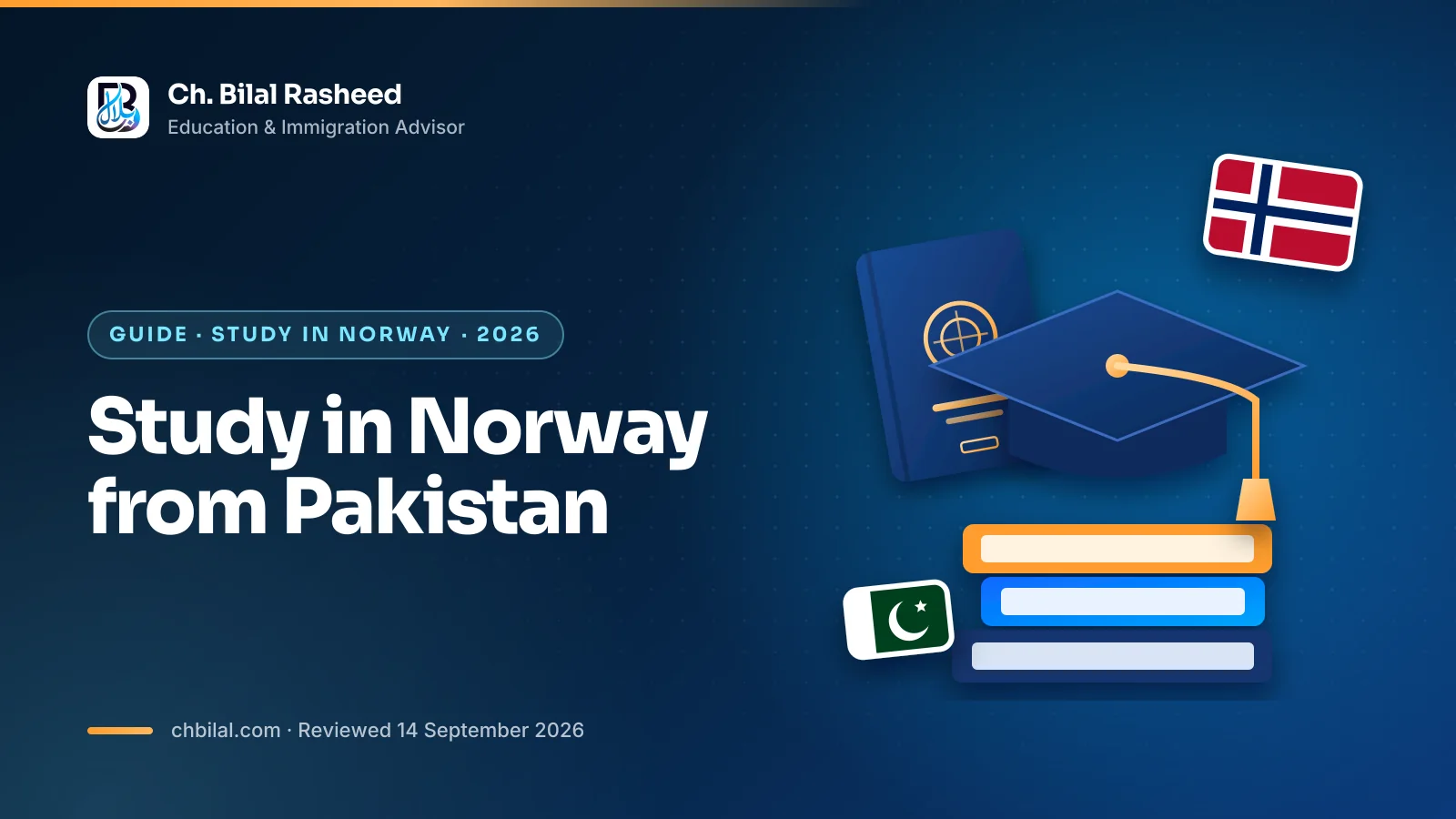
You apply straight to the Norwegian institution, usually by 15 November or 1 December for the following autumn, after checking that your Pakistani certificates meet the Higher Education Entrance Qualification for Pakistan. A bachelor’s applicant needs a Higher Secondary Certificate or Intermediate certificate plus one year of university education. Then you apply yourself for a study permit from the Norwegian Directorate of Immigration. As of 9 October 2026 the fee is NOK 5,400 and you must show at least NOK 15,488 a month, or NOK 170,368 for a full academic year, held in a Norwegian bank account or the institution’s deposit account. Tuition is extra and set by each institution.
How does studying in Norway work for Pakistani students?
Norway separates the two decisions completely. The institution decides admission. The Norwegian Directorate of Immigration, known in Norway as UDI, decides whether you may live there. Nothing in the immigration stage can repair a weak admission file, and nothing an agent does can shorten either stage.
Four bodies matter to a Pakistani applicant. The Norwegian Directorate for Higher Education and Skills publishes the Study in Norway portal and the Higher Education Entrance Qualification list, which is the list that decides whether your Pakistani certificates count at all. NOKUT, the Norwegian Agency for Quality Assurance in Education, accredits institutions and handles recognition of foreign higher education. The university or university college sets its own entry requirements, runs the selection and issues the admission letter and the tuition invoice. The Directorate of Immigration decides the study permit.
You file the permit application yourself
The study permit is your application, in your name, and you pay the fee. The institution supplies documents and, in many cases, a deposit account for the living funds, but it does not apply on your behalf. That is worth saying plainly, because packages sold in Pakistan often price the permit application as a service when the work involved is filling in a form and attending an appointment with your own passport.
If you are still weighing countries, the comparison of study destinations sets the main options side by side, and the Finland guide and Sweden guide show how differently two neighbouring systems organise the same steps.
What happens in what order
Admission first, always. You cannot apply for a study permit without a place, and the institutional deadlines for international applicants fall in November and December for an autumn start nine or ten months later. A student who begins collecting transcripts in March has usually already lost the intake, and the Norwegian calendar gives no late route.
What qualification do you need, and what does the list say for Pakistan?
This is where most Pakistani plans for Norway fail, and it fails early. The general basis for admission to Norwegian universities and university colleges is called the Higher Education Entrance Qualification. For applicants with foreign education, the requirements are set out country by country in what Norway calls the GSU list, published by the Directorate for Higher Education and Skills and used by the national admission service, by the institutions and by the Directorate itself when it assesses recognition of foreign education.
As of 9 October 2026, the Pakistan entry on that list states the education requirement as one of two options: a Higher Secondary Certificate plus one year of university education, or an Intermediate Examination Certificate plus one year of university education. The same entry marks English language requirements for Pakistan as yes. The list page records that it was last updated on 15 March 2023, and that the countries revised in December 2025 were Armenia, Cambodia and Laos, so Pakistan was not among them.
Read that requirement slowly. An FSc, an FA or an Intermediate certificate on its own does not meet the Norwegian education requirement for a bachelor’s degree. You need a completed year of recognised higher education on top of it, from a recognised programme at a recognised institution in Pakistan. A student who has finished two years of a BS at an HEC-recognised university is in a far stronger position than one who has just received an Intermediate result.
What this means in practice
- School leavers. If you have only just finished FSc, Norway is not an immediate option for a bachelor’s degree. Either complete a year of university in Pakistan first, or look at destinations whose entry rules accept an Intermediate certificate directly.
- Partial degree holders. One completed year of recognised university study can satisfy the education requirement, but the programme you apply to may still want more. Check both.
- Master’s applicants. The entrance qualification list governs undergraduate admission. For a master’s, the institution assesses your bachelor’s degree against the programme’s academic requirements, and a four-year BS from an HEC-recognised university is the normal starting point. Ask the admissions office in writing whether your specific degree is accepted for direct entry.
- Norwegian-taught programmes. Applicants with education from outside the Nordic countries must also document Norwegian language proficiency for these, at the levels the entrance qualification sets. That requirement rules out Norwegian-taught degrees for almost every fresh applicant from Pakistan.
Accreditation is a permit condition, not just a quality signal
As of 9 October 2026, the Directorate of Immigration’s study permit page says the place of study must be included on NOKUT’s list of approved, accredited institutions. That makes accreditation an immigration requirement and not merely academic advice. If an institution is not on that list, no amount of paperwork produces a study permit, and the money you paid for the admission is gone.
When do you apply, and do you apply to the institution or to a portal?
Norway runs two routes, and Pakistani applicants almost always use the second one.
The national admission service, Samordna opptak, coordinates admission to undergraduate programmes at universities, state university colleges and some private university colleges. As of 9 October 2026 its English pages give 15 April as the application deadline for most applicants, 1 March for early admission, special assessment and a small number of named programmes, 1 July as the deadline for uploading spring exam results, and 20 July as the day results are posted to your account. It also says postgraduate programmes sit outside the coordinated service and that applicants should check each institution’s own website.
In practice, the English-taught degrees that Pakistani applicants want are handled by the institutions directly, with their own earlier deadlines for applicants who need a study permit. The pattern across published programme pages on the Study in Norway portal is consistent.
| Route | Who uses it | Typical deadline | Where the date is published |
|---|---|---|---|
| Direct application to the institution | Applicants from outside the EU and EEA, for English-taught degrees | Commonly 15 November or 1 December for the following autumn, with some programmes using 15 December | The programme page on the institution’s own website and on the Study in Norway portal |
| Direct application, EU and EEA applicants | Applicants who do not need a study permit | Commonly 15 April | The same programme page |
| Samordna opptak, the national admission service | Undergraduate admission, mainly to Norwegian-taught programmes | 15 April for most applicants; 1 March for early admission and special assessment | The national admission service’s own deadline pages |
| Master’s and postgraduate admission | All applicants | Set by each institution, often between November and January for non-EEA applicants | The institution’s own admission pages |
Do not take a single date from any guide, including this one, as the deadline for your programme. Open the programme page, find the line that names applicants from outside the EU and EEA, and screenshot it with the date visible. Deadlines differ between two programmes at the same university.
What English level do you need for a Norwegian degree?
There are two layers, and confusing them wastes money on the wrong test date.
The first layer is the general entrance qualification. As of 9 October 2026, the language requirements page for the Higher Education Entrance Qualification accepts IELTS Academic with 5.0 overall, TOEFL iBT with 60 points, TOEFL paper based with 500 points, PTE Academic with 51 overall, and the Cambridge First Certificate in English, Certificate in Advanced English or Certificate of Proficiency in English. It also accepts certain degrees or study periods taught in English and some other named certificates.
| Test | Minimum for general entrance | Note |
|---|---|---|
| IELTS Academic | 5.0 overall | Also accepted in the Online Academic form |
| TOEFL iBT | 60 points | Also accepted in the iBT Home Edition form |
| TOEFL paper based | 500 points | Listed alongside the iBT score |
| PTE Academic | 51 overall | Also accepted in the PTE Academic Online form |
| Cambridge English | FCE, CAE or CPE | No minimum score published for these certificates |
The second layer is your programme. These entrance minimums are a floor for admission to Norwegian higher education in general. A competitive master’s in engineering or business will ask for considerably more, often an overall band with minimums in each individual section. Read the programme page, write the score down, and only then book the test.
Applicants whose degree was taught in English sometimes hope a medium-of-instruction letter will replace a test. The entrance qualification does recognise some degrees and study periods taught in English, but whether yours qualifies is a question for the institution and for the Directorate for Higher Education and Skills, not for an agent. Ask in writing and keep the reply.
How much is tuition in Norway, and what changed in August 2026?
Norway was free, then it was not, and the rule behind the fee has just been loosened. That sequence explains why so much online advice about Norway is wrong.
Fees arrived in autumn 2023
Until 2023, Norwegian public institutions charged no tuition for ordinary degree programmes, whatever the student’s nationality. Fees for degree students from outside the EEA and Switzerland were introduced from the autumn 2023 semester. The effect was immediate and documented: a report published by the Directorate for Higher Education and Skills on 17 November 2023 found a marked fall in admitted degree students from countries outside the EEA, with enrolment at master’s level down 59 per cent in the autumn 2023 semester compared with 2022, and the rise in EEA and Swiss students nowhere near enough to make up the difference.
What the law says now
As of 9 October 2026, section 2-6 of the Universities and University Colleges Act requires state universities and university colleges to charge tuition from students who are citizens of countries outside the EEA or Switzerland. The section lists the exemptions, and the Ministry may make further exceptions by regulation.
The change that matters is what the section no longer says. The earlier wording required the fee to at least cover the institution’s costs for the education, which is why Norwegian fees jumped to levels that surprised everyone. An amending Act of 19 June 2026 came into force on 1 August 2026 and removed that minimum. Institutions must still charge a fee, but they may now set a lower one. The Norwegian government, in announcing the change, said the number of new students from fee paying countries had fallen by around 80 per cent since 2023, with the steepest decline in science, craft and technical subjects.
I am not going to translate that into a prediction. What it means for you is narrow and practical: a fee quoted for 2024 or 2025 may no longer be the fee for your start year, in either direction, and you have to read the current published figure for your own programme.
Why this guide gives you no tuition range
Because the official source does not publish one. As of 9 October 2026, the Study in Norway portal says only that degree seeking students from outside the EU, EEA and Switzerland must normally pay tuition fees at Norwegian institutions and that the amount varies between institutions and study programmes. It gives no national range, no average and no typical figure. Every range you see quoted for Norway online comes from somewhere else, usually a single university’s page, and the spread between institutions and between subjects is wide.
So the honest instruction is the inconvenient one. Open the programme page for your start year, find the tuition line, and budget from that. Ask the institution in writing whether the figure is per year or per semester, when each instalment falls due, and what happens to it if your permit is refused.
| Item | Official figure | Who publishes it |
|---|---|---|
| Tuition, degree programmes at state institutions | Charged, with the amount varying between institutions and programmes; no national figure published | Study in Norway, and section 2-6 of the Universities and University Colleges Act |
| Tuition, doctoral candidates | Exempt | Study in Norway and the Act |
| Semester fee to the student welfare organisation | Approximately NOK 1,000 per semester, compulsory to study and sit exams | Study in Norway |
| Study permit application fee | NOK 5,400, with children under 18 paying half | Section 17-10 of the Immigration Regulations, and the Directorate of Immigration fee page |
| Living funds for the study permit | At least NOK 15,488 a month, or NOK 170,368 for a full academic year | Directorate of Immigration, and Study in Norway for 2026 to 2027 |
| Job seeker permit after graduation, own funds | At least NOK 28,448 a month | Directorate of Immigration |
Are there scholarships for Pakistani students in Norway?
There are named schemes, and they are narrow. The exemption list in the Universities and University Colleges Act and on the Study in Norway portal is itself the best map of where funded places exist, because the students who do not pay tuition are the ones covered by a scheme.
- Doctoral candidates pay no tuition, whatever their nationality. A PhD in Norway is normally a salaried position, applied for as a job, not a self-funded degree.
- Students on institutional exchange programmes are normally exempt, unless the exchange agreement says otherwise. That requires your home university to hold an agreement with the Norwegian institution.
- Students on the NORPART and NORHED programmes are exempt. These are partnership programmes between Norwegian institutions and partners in selected countries, so eligibility depends on your own university being a partner.
- Students on the Students At Risk scheme and the Fulbright programme are exempt, as are students on Erasmus Mundus joint degrees and some other joint degrees offered with international partners.
- People entitled to equal treatment with Norwegian citizens under international agreements, and people eligible for Norwegian student loans and grants on the same terms as Norwegian citizens, are exempt.
What that list does not contain is a general Norwegian government scholarship for self-funded international students. Treat any advertisement for a fully funded Norway government scholarship covering tuition, flights and living costs with the suspicion you would give any other unsourced promise, and ask which of the schemes above it claims to be. Individual institutions sometimes offer their own tuition waivers or grants, and those are published on the institution’s own scholarship page, which is where to look.
One more point about money and the permit. The Directorate of Immigration’s study permit page allows the living funds to be made up of student loans, grants or your own funds. An awarded grant you can document is useful. An application for a grant is not an award, and will not carry a permit application.
How do you get the study permit from the Directorate of Immigration?
A Pakistani student who will study in Norway for more than 90 days needs a study permit. You apply after you have been admitted, you register the application in the Directorate of Immigration’s Application Portal, you pay the fee, and you hand in your documents in person at the application centre named for Pakistan.
What the Directorate requires
As of 9 October 2026, its study permit page for university and university college applicants sets out the conditions.
- You must pay the application fee.
- You must have been admitted to a university college or university.
- You must study full-time.
- Your place of study must be on NOKUT’s list of approved, accredited institutions.
- You must have enough money to live on for the period you are going to study, which the Directorate puts at at least NOK 15,488 a month, or NOK 170,368 a year for a full academic year.
- You must have somewhere to live.
- If you pay tuition, you must cover it or show in the application that it has already been paid. If you have paid for one semester, the Directorate asks for documentation that you have enough money for the second semester.
The fee
As of 9 October 2026, section 17-10 of the Immigration Regulations sets the processing fee for cases concerning students at NOK 5,400, and a paragraph that took effect on 1 January 2026 provides that children under 18 pay half. The Directorate’s own fee page lists NOK 5,400 for applicants over 18, including renewals, and NOK 2,700 for applicants under 18. The fee is paid no later than when the application is submitted, and it is not refunded if the application is refused.
Fees in Norway are set by regulation and amended by regulation, often with effect from 1 January or 1 April. The section has been amended many times, most recently by a regulation of 27 February 2026 that came into force on 1 April 2026. Read the Directorate’s fee page in the month you apply rather than trusting a figure from a guide.
How long processing takes
The Directorate publishes a waiting time guide for study permits rather than a single national number, and two features of it change how you should plan. First, the waiting time is counted from the day you hand in your documents to the police or to a visa application centre, not from the day you register the application online. Second, the estimate can change while your file is being processed, and the new estimate applies even if you were given a different one when you submitted. The Directorate says it aims to give applicants an answer before they need to start studying, that it recommends applying early, and that it refreshes the guide once a month.
I am not going to put a number on it, because the official page does not give one that applies to all applicants. Read the guide yourself on the day you submit, answer its questions for your own case, and treat the document appointment as the date that starts the clock.
How much money must you show, and where does it have to sit?
This is the requirement that trips up Pakistani families most often, and not because of the amount. It is the location of the money.
As of 9 October 2026, the Directorate of Immigration requires at least NOK 15,488 a month, or NOK 170,368 a year for a full academic year. The Study in Norway portal publishes the same figures for the 2026 to 2027 academic year. The Directorate ties the figure to the basic support rate that Lånekassen, the Norwegian State Educational Loan Fund, pays for full-time higher education, which is set for each academic year and therefore moves. For a single semester, the Directorate asks for NOK 77,440 for the autumn semester and NOK 92,928 for the spring semester.
| Situation | Amount required | Where it must be held |
|---|---|---|
| A full academic year | NOK 170,368 | A Norwegian bank account or the institution’s deposit account |
| Per month | At least NOK 15,488 | The same |
| Autumn semester only | NOK 77,440 | The same |
| Spring semester only | NOK 92,928 | The same |
| Tuition still unpaid | The tuition amount, in addition to the living funds | Documented in the application |
| Renewal | The same monthly and yearly amounts | The same |
A Norwegian account, or the institution’s deposit account
The Directorate’s study permit page says the money may consist of student loans, grants, your own funds held in a Norwegian bank account or the educational institution’s deposit account, or a combination of those. It adds that if you do not have a Norwegian bank account you can use the account at your school, and that you must contact the institution where you are going to study for the details of that arrangement.
Read that twice, because it changes the order of your preparation. You cannot simply print a statement from a Pakistani bank and attach it. The normal route is that the institution tells you, after admission, how to transfer the living funds into a deposit account it controls, and releases the money to you in instalments after you arrive. So the sequence is admission, then written instructions from the institution, then the transfer, then the permit application.
Practically, that means starting the State Bank of Pakistan paperwork and the bank transfer early, keeping every receipt and exchange advice, and being able to explain where a large deposit came from. It also means not letting anyone hold the money on your behalf. An offer to arrange or park the funds for a fee is the single clearest sign to walk away.
Remember too that NOK 15,488 a month is an immigration minimum tied to a student support rate, not a comfortable budget for Oslo. Tuition, travel, insurance and the semester fee all sit on top of it.
Where do Pakistani applicants submit the application?
Not at an embassy counter in Islamabad, and not by post. As of 9 October 2026, the Norway in Pakistan pages of the Norwegian Ministry of Foreign Affairs say that applications for a visitor’s visa or residence permit from Pakistan are handled by the visa hub in Abu Dhabi and by the Directorate of Immigration in Norway, and that the Norwegian Embassy in Abu Dhabi handles all visa applications. The same page says you may need to get an appointment at VFS Global, and links to the VFS Global pages for Norway in Pakistan.
The embassy in Islamabad remains open for consular matters, but the same page says it does not respond to visa enquiries by telephone and directs visa and residence permit questions to the service provider. VFS Global has operated Norway application centres in Islamabad, Karachi and Lahore for residence permit applications, with a prebooked appointment required, mobile phones not permitted inside and accompanying family members not admitted. I am describing the arrangement rather than promising it, because service scope at these centres changes and the published pages are not all recent.
- Read the Norway in Pakistan page on regional handling of visas and residence permits, and the VFS Global pages for Norway in Pakistan, on the day you plan to submit.
- Register and pay in the Directorate of Immigration’s Application Portal first, print the application and the checklist it generates for your case, then book the appointment.
- Expect the centre to take your biometrics and to forward the file. The decision is made by the Directorate of Immigration in Norway, not at the counter.
- Budget for a service fee charged by the application centre on top of the NOK 5,400 permit fee.
- Submit documents as the checklist asks. Missing documents mean a longer wait or a refusal, and the waiting time only starts once your documents are in.
Anyone who tells you the Norwegian study permit is decided at an interview in Islamabad is working from an old page. Anyone who offers to attend the appointment for you is describing something that cannot be done, because the appointment exists to take your fingerprints and photograph.
How do you find accommodation, and what is the semester fee?
Student housing in Norway is run by the student welfare organisations, the samskipnader, rather than by the institutions themselves. Each institution is served by one, and it provides housing alongside health, childcare and campus food services.
As of 9 October 2026, the Study in Norway portal says all students must pay a semester fee to their student welfare organisation in order to be allowed to study and sit exams at the institution, and gives the amount as approximately NOK 1,000 per semester. It is compulsory, it is small relative to tuition, and students who forget it discover the problem when they are blocked from an examination.
- Apply for student housing as soon as your admission is confirmed. Demand peaks at the start of the academic year and the earliest applications get the rooms.
- Ask the institution’s international office which welfare organisation serves your campus and how its housing application works.
- Remember that the Directorate of Immigration lists having somewhere to live as a permit condition, so a confirmed housing offer is useful to the application and not only to you.
- The open market, including social media listings, is more expensive and is where rental fraud against international students happens.
- Never pay a deposit for a room that nobody at the institution or the welfare organisation can confirm exists.
What do you do after you arrive in Norway?
Your permit is granted before you travel, but the card that proves it is ordered in Norway. The Directorate of Immigration says that people who applied from abroad must meet the police to order a residence card, and that you may start studying or working before the card arrives if you have been granted a permit that allows it and have booked a police appointment to order one. If you cannot get a police appointment, the Directorate asks you to contact it by phone or email to report that you are in Norway and starting your studies.
- Book the police appointment as early as you can. Waiting times for appointments vary a great deal between police districts, and that is the step students underestimate.
- Bring your passport, your decision letter and your confirmation of admission. The police take your fingerprints and photograph and order the card.
- Ask your institution about joint arrangements. Many hold registration events with the authorities at the start of each semester, which is the easiest route.
- Keep your decision letter. Until the card arrives it is what documents your legal residence.
A Norwegian identity number and a tax card follow from registration and are what you need before a bank account or a part-time job is possible. Treat the first fortnight in Norway as administrative, not social.
Can you work while studying in Norway?
Yes, within a weekly limit, and the limit is firmer than in most of the rest of Europe. As of 9 October 2026, the Directorate of Immigration says a study permit automatically carries permission to work part-time for up to 20 hours a week while you are studying, including remote work, and full-time during holidays. The Study in Norway portal states the same rule.
- You may not start working until the permit has been granted. Not when you arrive, and not when the decision is in the post.
- Full-time work during the academic year needs separate approval and is granted only where the work forms part of your education plan. You must ask for it in writing, either with the application or afterwards.
- You cannot be self-employed or run your own business in Norway on a study permit. Freelance invoicing is not a workaround.
- At renewal, the right to work is reassessed, and the Directorate says you can only work if your place of study is of the opinion that you will be able to manage work in addition to your studies.
- Working more than the permit allows is listed by the Directorate among the reasons a residence permit can be lost, alongside not studying and living abroad for more than six months in a year.
Now the arithmetic nobody selling a package will do for you. Twenty hours a week of part-time work in Norway does not fund a Norwegian tuition fee, and the Directorate will not count a hoped-for job towards your first permit at all, because the funds have to be in an account before you apply. Plan the money without the job. If the job comes, it improves your year rather than making it possible.
How do you renew the study permit?
A Norwegian study permit is renewed as your programme continues, and the test at renewal is progress. As of 9 October 2026, the Directorate of Immigration’s renewal page for study permits sets out the conditions.
- You must still hold a place on a study programme at a university college, university, vocational school or upper secondary school, and the education must be full-time.
- You must have had normal study progression, which the Directorate explains as not being more than one year behind in your studies.
- You must show the same living funds, at least NOK 15,488 a month or NOK 170,368 for the academic year.
- You must pay the application fee again, which section 17-10 of the Immigration Regulations and the Directorate’s fee page both put at NOK 5,400 for applicants over 18, renewals included.
- You cannot be self-employed or run your own business in Norway.
Timing is the part students get wrong. If you renew using electronic identification, the Directorate says to register, pay and upload your documents no later than one month before your permit expires. If you apply with a username and password you also need a police appointment to hand in documents, and the Directorate suggests starting two to three months ahead because appointments can be slow. Filing at least a month early is what preserves the rights your current permit gives you while you wait. Apply after the permit has expired and you do not automatically keep those rights.
The practical consequence is that a failed year is an immigration problem as well as an academic one. If you are falling behind, speak to your institution long before the renewal window, because a documented reason for delay is worth having and a surprise is not.
What happens after graduation?
Norway publishes a route for recent graduates to stay and look for skilled work. As of 9 October 2026, the Directorate of Immigration’s job seeker page says that a graduate who holds a student residence permit, has completed their degree or education in Norway, and applies before that permit expires may be granted a permit to look for work, that it can be granted for a maximum of one year, and that although it is renewable the total cannot exceed one year. It advises applying at least one month before the student permit expires.
Two conditions matter when you are deciding between countries now. The funds requirement is far higher than the student one, at least NOK 28,448 a month, and the money must be your own and is normally required to be in a Norwegian bank account, although income from a relevant job offer you already hold can be counted. And the permit does not count towards a later permanent residence permit. A holder may work full-time or part-time while searching, including in unskilled work in the meantime, but may not be self-employed.
If the diploma is not ready, the Directorate accepts a confirmation from the institution that you have submitted your final thesis and completed all the other credits, showing the date. What a graduate does after that is a work route with its own rules, and this site does not publish work visa guides. The point for a family comparing countries today is that Norway has a published, time limited path after the degree, and that the money needed to use it is substantial.
How do you spot a fake offer or an agent promise that cannot be kept?
Norway has three checks that are quick, free and decisive. Most of what is sold in Pakistan about Norway fails at least one of them.
The three checks
- Is the institution accredited? The Directorate of Immigration requires your place of study to be on NOKUT’s list of approved, accredited institutions. If it is not on that list, there is no study permit, whatever the admission letter says.
- Do your certificates meet the Pakistan entry on the entrance qualification list? A Higher Secondary Certificate or Intermediate certificate plus one year of university education. If someone has told a fresh FSc student that Norway will take them straight into a bachelor’s degree, that is wrong on the face of the published list.
- Does the programme page show the fee and the deadline? Both are published by the institution. A quote that bundles tuition, the permit fee and an unexplained service charge into one lump sum is hiding which part is which.
What to walk away from
- Anyone selling a guaranteed Norwegian student visa. The Directorate of Immigration decides, and you sign the application yourself.
- Anyone claiming to arrange a Norway government scholarship covering tuition, flights and living costs. The exemptions from tuition are a published list of named schemes, and none of them is a general government scholarship for self-funded applicants.
- An offer to arrange the living funds for a fee, or to place money in an account for a week. The funds have to be your own, in a Norwegian bank account or the institution’s deposit account.
- An admission letter you cannot confirm by emailing the admissions address published on the institution’s own website, never the address printed in the letter.
- An agent who says the appointment or the interview happens at the Norwegian Embassy in Islamabad. The published pages say applications from Pakistan are handled by the visa hub in Abu Dhabi and by the Directorate in Norway.
- Anyone who wants to keep your original passport, or who asks you to sign a form you have not read.
- Anyone quoting a Norwegian tuition figure without naming the programme page it came from, especially now that the fee rules changed on 1 August 2026.
The guide to checking a visa consultant in Pakistan sets out the registration checks and where to report fraud. If a previous application was refused, for any country, read the guide to student visa refusals before you file, because immigration forms ask about your history. And if you have already paid someone and have doubts, you can book a free first consultation and bring the receipts and messages.
How do you apply, step by step?
Work backwards from the institution’s deadline for applicants outside the EU and EEA, and forwards from the entrance qualification. The order below is the one that wastes the least time and money, because the two steps that most often end a Norwegian plan, the entrance qualification and the accreditation check, both come before you spend anything.
Check the Pakistan entry on the GSU list first
Before anything else, read what the Higher Education Entrance Qualification list says for Pakistan. The Norwegian Directorate for Higher Education and Skills publishes it, and the Pakistan entry asks for a Higher Secondary Certificate plus one year of university education, or an Intermediate Examination Certificate plus one year of university education, and it marks English language requirements as yes. An FSc or an Intermediate certificate on its own does not meet the education requirement for a Norwegian bachelor’s degree.
Shortlist programmes at institutions NOKUT has accredited
Search the Study in Norway portal, run by the Directorate for Higher Education and Skills, for the degree you want. Then check that the institution appears on the list of accredited institutions kept by NOKUT, the Norwegian Agency for Quality Assurance in Education, because the Directorate of Immigration requires your place of study to be on that list before it will grant a study permit.
Sit the English test the programme names, not the one you heard about
The general entrance qualification sets a floor for English, and individual programmes set their own higher minimums. Read the programme page, note the exact test and score it will accept, and sit the test early enough for the result to reach the institution inside its deadline.
Apply directly to the institution inside its own deadline
Applicants with foreign education from outside the EU and EEA normally apply straight to the Norwegian institution for English-taught degrees, not through the national admission service. Published deadlines for the following autumn commonly fall on 15 November or 1 December, and each institution sets its own, so confirm the date on the programme page rather than trusting a single national date.
Accept the offer and collect the documents in writing
Once you are admitted, ask the institution for the admission letter, the tuition invoice or the fee exemption decision, confirmation of the semester fee, and written instructions on how it wants the living funds held. Those papers are what the permit application rests on.
Put the living funds where the Directorate of Immigration can see them
The Directorate of Immigration requires at least NOK 15,488 a month, or NOK 170,368 for a full academic year, and its study permit page says the money may be student loans, grants or your own funds held in a Norwegian bank account or the educational institution’s deposit account. Ask the institution which arrangement it uses before you transfer anything, and keep the tuition money separate.
Register the study permit application and pay the fee
Register the application in the Directorate of Immigration’s Application Portal, answer the questions for a study permit, print the checklist it generates for your situation, and pay the application fee. As of 9 October 2026 the Immigration Regulations set that fee at NOK 5,400 for a study permit, with children under 18 paying half.
Hand in documents and biometrics, then register in Norway
Book an appointment and hand in your passport, the printed application and the checklist documents at the application centre named for Pakistan. The waiting time the Directorate of Immigration publishes is counted from the day you hand in your documents, not from the day you register online. After a positive decision and arrival in Norway, meet the police to order your residence card.
What goes wrong most often?
Assuming an Intermediate certificate is enough
It is not, for a Norwegian bachelor’s degree. The Pakistan entry on the entrance qualification list asks for a Higher Secondary Certificate or an Intermediate Examination Certificate plus one year of university education. Families who discover this after paying an agent have usually lost both the money and the intake.
Using a 2024 tuition figure
Fees arrived in autumn 2023 under a rule that required them to cover the institution’s costs. That minimum was removed with effect from 1 August 2026. Any figure you were quoted before then may be wrong, and the official portal publishes no range at all, so the programme page is the only source.
Keeping the funds in a Pakistani account
The Directorate of Immigration’s wording is specific: a Norwegian bank account or the institution’s deposit account. Students who prepare a beautiful Pakistani bank statement and nothing else have prepared the wrong document, and the transfer takes longer than they expect.
Mixing tuition money with living funds
If the tuition is unpaid, the Directorate wants the tuition covered as well as the living funds, and if you have paid one semester it wants documentation that the second semester is funded. One pot of money counted twice does not satisfy both.
Registering online and then waiting
The published waiting time runs from the day your documents are handed in, not the day you register in the Application Portal. A student who registers in May and attends the appointment in August has not been waiting since May in any sense the Directorate recognises.
Treating the semester fee as optional
Approximately NOK 1,000 a semester, and the Study in Norway portal says you must pay it to be allowed to study and sit exams. It is the smallest number in this guide and the easiest one to be caught by.
Planning on part-time earnings
Twenty hours a week, no self-employment, no work at all before the permit is granted, and no credit for a promised job at the first permit stage. A plan that depends on Norwegian wages to pay Norwegian tuition is not a plan.
A realistic example
This is a hypothetical illustration, not a real client. Usman is from Gujranwala. He finished FSc pre-engineering with good marks, then completed two years of a BS in mechanical engineering at an HEC-recognised university. He wants an English-taught master’s in Norway and his elder brother, who works in Dubai, will fund him. He is looking at an autumn 2027 start.
- October 2026. He opens the entrance qualification list and reads the Pakistan entry. Because he is applying for a master’s, the institution will assess his bachelor’s degree instead, so he writes to two admissions offices asking in writing whether a four-year BS from his university is accepted for direct entry. He also checks both institutions against NOKUT’s accredited list.
- November 2026. One institution replies that it needs the completed degree, so he parks that option until his BS finishes. For the other he notes the deadline for applicants outside the EU and EEA, the published tuition fee for 2027, the English requirement and the document list, and screenshots all four.
- December 2026. He sits IELTS Academic because the programme names it, and scores above the programme minimum rather than the general entrance minimum of 5.0. He renews his passport, which had 19 months left.
- Spring 2027. He completes his BS, has the final transcript and degree issued, and submits the Norwegian application inside the institution’s window for his start year, having confirmed that window on the programme page rather than from a guide.
- May 2027. He is admitted. He asks the institution for the admission letter, the tuition invoice, confirmation of the semester fee, and written instructions for the living funds. The institution sends deposit account instructions and a date by which the money must arrive.
- June 2027. His brother transfers the tuition instalment to the institution and the living funds to the deposit account the institution named, keeping both separate and keeping every receipt and exchange advice. Usman arranges accommodation through the student welfare organisation serving the campus.
- Late June 2027. He registers the study permit application in the Application Portal, pays the fee, prints the application and the checklist it generates for his case, and books the appointment at the application centre. He does this the week the documents are complete, not in August.
- July 2027. He hands in his documents and gives his biometrics. That is the day the published waiting time starts. He reads the waiting time guide and plans for the longer end of it.
- August 2027. The decision is positive. He travels, books a police appointment to order his residence card, pays the semester fee, and does not look for a part-time job until his first assessments are behind him.
Nothing in that sequence is clever. Every step happened in the order the published rules require, with time in hand, and the two expensive checks came before any money moved.
The version that goes wrong
Now imagine his cousin Hamza, 19, with an FSc and nothing after it. An agent sells him admission plus visa to a Norwegian institution for a lump sum, promises a fully funded Norway government scholarship, and says the interview will be at the embassy in Islamabad. The entrance qualification list says an Intermediate certificate alone does not meet the education requirement. The institution is not on NOKUT’s accredited list, so even a genuine admission would not support a permit. There is no general Norwegian government scholarship for self-funded applicants. The published pages say applications from Pakistan are handled by the visa hub in Abu Dhabi. By the time the family works this out the intake has passed and there is nothing to appeal, because no Norwegian authority ever received an application in his name.
Key takeaways
- The Pakistan entry on the Higher Education Entrance Qualification list asks for a Higher Secondary Certificate or Intermediate Examination Certificate plus one year of university education, and marks English as required. An FSc alone is not enough for a Norwegian bachelor’s degree.
- Applicants from outside the EU and EEA normally apply directly to the institution for English-taught degrees, with published deadlines commonly on 15 November or 1 December for the following autumn. Samordna opptak’s 15 April deadline mainly serves Norwegian-taught undergraduate admission.
- Degree students from outside the EEA and Switzerland have paid tuition since the autumn 2023 semester, and the Study in Norway portal publishes no national range, so the only reliable figure is the one on your programme page.
- An amending Act in force on 1 August 2026 removed the requirement that the fee at least cover the institution’s costs, so institutions may now set lower fees while still having to charge one. Check your programme’s current published fee.
- As of 9 October 2026 the study permit fee is NOK 5,400, with children under 18 paying half, set by section 17-10 of the Immigration Regulations and listed on the Directorate of Immigration fee page.
- The living funds requirement is at least NOK 15,488 a month, or NOK 170,368 for a full academic year, and the Directorate requires it in a Norwegian bank account or the institution’s deposit account, not a Pakistani account alone.
- Your place of study must be on NOKUT’s list of accredited institutions, which makes accreditation an immigration condition and a free five-minute check against a fake offer.
- A study permit allows up to 20 hours of part-time work a week while studying, including remote work, and full-time work during holidays. You cannot start before the permit is granted and cannot be self-employed.
- Renewal requires normal study progression, meaning not more than one year behind, the same funds, and an application filed at least one month before the permit expires.
- A graduate may apply for a job seeker permit of up to one year in total, but must have completed the degree in Norway, apply before the student permit expires, and show at least NOK 28,448 a month of their own funds.
Frequently asked questions
Do Pakistani students pay tuition fees in Norway?
Yes, in almost every case. Norway introduced tuition fees for degree students from outside the EEA and Switzerland from the autumn 2023 semester. The Study in Norway portal says degree seeking students from outside the EU, EEA and Switzerland must normally pay tuition fees at Norwegian institutions and that the amount varies between institutions and study programmes. Section 2-6 of the Universities and University Colleges Act requires state institutions to charge it. Exemptions are narrow and cover doctoral candidates, exchange students, people entitled to equal treatment under international agreements, people eligible for Norwegian student loans and grants, and students on named schemes such as NORPART, NORHED, Fulbright, Students At Risk and Erasmus Mundus joint degrees.
How much is tuition in Norway for a Pakistani student?
There is no national figure, so treat any single number you are quoted with suspicion. As of 9 October 2026 the Study in Norway portal states only that fees vary between institutions and study programmes, and it publishes no range. The fee for your programme is set and published by the institution itself, so the only reliable number is the one on the programme page for your start year. Read it before you apply, and get the invoice in writing before you move any money.
Did the Norwegian tuition fee rules change in 2026?
Yes, and it is the most important recent change for a fee paying applicant. The original rule required the fee to at least cover the institution’s costs for the education, which pushed fees high. An amending Act of 19 June 2026 came into force on 1 August 2026 and removed that minimum from section 2-6 of the Universities and University Colleges Act, so institutions may now set lower fees while still being required to charge one. The Norwegian government said it made the change because the number of new fee paying students had fallen by around 80 per cent since 2023. Fees are still set institution by institution, so compare the published figures for your own start year rather than assuming yours has dropped.
How much money must I show for a Norwegian study permit?
As of 9 October 2026, the Norwegian Directorate of Immigration requires at least NOK 15,488 a month, or NOK 170,368 a year for a full academic year. It ties the figure to the basic support rate that Lånekassen, the Norwegian State Educational Loan Fund, pays for full-time higher education, and that rate is set for each academic year, so the amount moves. For a single semester the Directorate asks for NOK 77,440 for the autumn semester and NOK 92,928 for the spring semester. The Study in Norway portal publishes the same monthly and yearly figures for 2026 to 2027.
Does the money have to be in a Norwegian bank account?
In practice, yes, or in the institution’s own deposit account. The Directorate of Immigration’s study permit page says the money may be student loans, grants, your own funds held in a Norwegian bank account or the educational institution’s deposit account, or a combination of those. Many Norwegian institutions open a deposit account for admitted international students for exactly this purpose, and tell you how and when to transfer. Ask your institution which route it uses before you send anything from Pakistan, because a statement from a Pakistani bank alone does not satisfy the rule as the page is worded.
How much is the Norwegian study permit application fee?
As of 9 October 2026, section 17-10 of the Immigration Regulations sets the processing fee for a study permit at NOK 5,400, and a paragraph added with effect from 1 January 2026 provides that children under 18 pay half. The Directorate of Immigration’s own fee page lists the same NOK 5,400 for applicants over 18, including renewals, and NOK 2,700 for applicants under 18. The fee is paid when the application is submitted and it is not refunded if the application is refused.
When is the deadline to apply to a Norwegian university from Pakistan?
Each institution sets its own, so there is no single date. For English-taught degrees starting the following autumn, published deadlines for applicants from outside the EU and EEA commonly fall on 15 November or 1 December, and some programmes use 15 December. The national admission service, Samordna opptak, coordinates undergraduate admission mainly to Norwegian-taught programmes, with 15 April as the deadline for most applicants, 1 March for early admission and special assessment, 1 July for uploading spring exam results and results posted on 20 July. Confirm the date on the programme page for your start year.
What qualification does a Pakistani student need for a Norwegian bachelor’s degree?
More than an Intermediate certificate. The Higher Education Entrance Qualification list, published by the Norwegian Directorate for Higher Education and Skills and last updated on 15 March 2023, gives the Pakistan requirement as a Higher Secondary Certificate plus one year of university education, or an Intermediate Examination Certificate plus one year of university education. It also marks English language requirements for Pakistan as yes. So an FSc or FA school leaver normally needs a completed year of recognised higher education in Pakistan before a Norwegian bachelor’s programme can admit them, and individual programmes may ask for more.
What English score do I need to study in Norway?
The entrance qualification sets the floor and the programme sets the real requirement. As of 9 October 2026, the language requirements page for the Higher Education Entrance Qualification accepts IELTS Academic 5.0 overall, TOEFL iBT 60, TOEFL paper based 500, PTE Academic 51 overall, and Cambridge First Certificate in English, Certificate in Advanced English or Certificate of Proficiency in English. Those are minimums for general entrance, not for your programme. Competitive master’s programmes routinely ask for higher overall scores and minimum band scores, so read the programme page and sit the test it names.
How many hours can I work on a Norwegian study permit?
As of 9 October 2026, a study permit automatically carries permission to work part-time for up to 20 hours a week while you are studying, including remote work, and full-time during holidays. You may not start working until the permit has been granted. Full-time work during the academic year needs separate approval and is only given where the work forms part of your education plan, which you must request in writing when you apply or afterwards. You cannot be self-employed or run your own business on a study permit, and the Directorate of Immigration lists working more than the permit allows among the reasons a residence permit can be lost.
Can I stay in Norway to look for work after I graduate?
There is a published route, with conditions. The Directorate of Immigration’s job seeker page says a recent graduate who holds a student residence permit, has completed the degree in Norway and applies before that permit expires may be granted a permit to look for skilled work for a maximum of one year in total, and it advises applying at least one month before the student permit expires. The funds requirement is much higher than the student one, at least NOK 28,448 a month, normally held in a Norwegian bank account. A holder may work full-time or part-time while searching but may not be self-employed. What happens after that is a work route with its own rules, which this site does not cover.
Can Ch. Bilal Rasheed help me study in Norway?
He offers a free first consultation in Lahore, on WhatsApp or by phone, with general guidance on institutions, programmes, the entrance qualification for Pakistani certificates and the documents the published rules ask for. No one can guarantee a permit or admission, and the decision belongs to the Norwegian Directorate of Immigration and to the institution. He is an ICEF-accredited education consultant and an immigration advisor in Pakistan, not a Norwegian lawyer.