Short answer
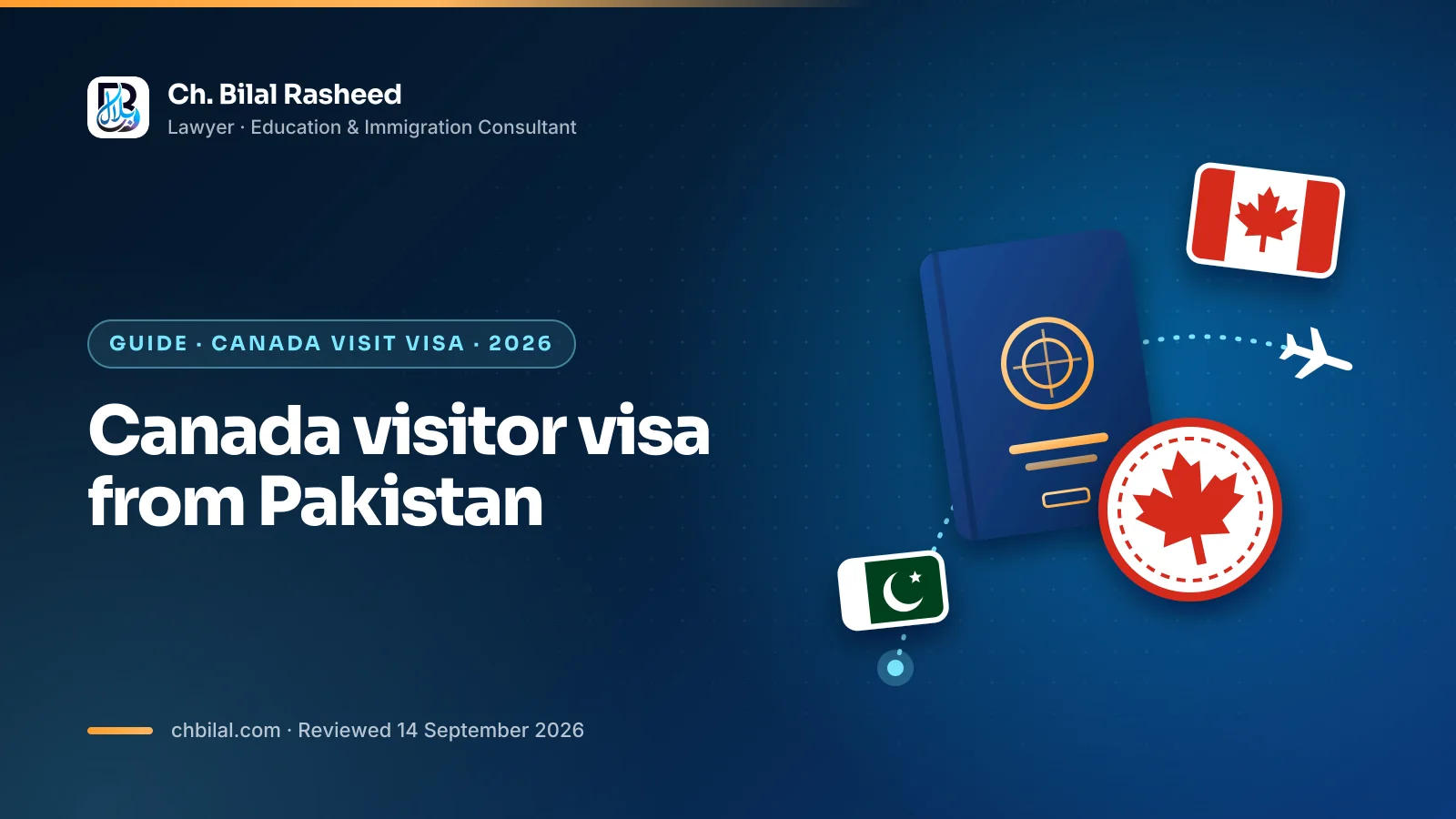
Pakistani citizens need a visitor visa, not an eTA, to visit Canada. As of 15 September 2026, IRCC charges CAD 100 per person plus CAD 85 for biometrics. You apply online, give biometrics at a VFS Global centre in Islamabad, Lahore or Karachi, and must show the officer your purpose, funds and ties to Pakistan.
Do Pakistanis need a visa or an eTA to visit Canada?
You need a visa. The IRCC entry requirements by country page lists Pakistan among the countries whose citizens need a visitor visa and a valid passport to visit or transit through Canada. Pakistanis cannot use an electronic travel authorisation (eTA) instead.
The visitor visa is formally called a temporary resident visa, or TRV. It covers tourism, visiting family, attending a wedding or convocation, and short business trips such as meetings or conferences. It does not allow you to work, and it is not a study permit.
IRCC’s visitor visa eligibility page asks for a valid passport, good health, enough money for your stay, and ties at home, such as a job, home, assets or family, that will take you back.
How long does a visitor visa let you stay?
Under section 183(2) of the Immigration and Refugee Protection Regulations, the authorised stay is six months, or another period an officer fixes based on your means, the period you applied for and your passport expiry. For much longer family visits, see the super visa below.
How much does a Canada visitor visa cost from Pakistan?
As of 15 September 2026, the IRCC fee list and the IRCC visitor visa application page both show the same figures. First-time applicants usually pay the visa fee and the biometrics fee together when they submit.
| Fee | Amount | Notes |
|---|---|---|
| Visitor visa, per person | CAD 100 | Also the starting fee for the super visa |
| Visitor visa, family | CAD 500 | Maximum for a family of five or more applying together |
| Biometrics, per person | CAD 85 | Children under 14 and applicants over 79 are exempt |
| Biometrics, family | CAD 170 | Maximum for family members applying at the same time |
A single adult giving biometrics for the first time pays CAD 185 in government fees. The rupee amount on your card statement depends on your bank’s exchange rate. If someone quotes one package price, ask which part actually goes to the Government of Canada.
Will you get a single or multiple entry visa, and for how long?
You do not choose the visa type in a way that binds the officer. According to IRCC’s help centre answer on single and multiple entry visas, a multiple entry visa lets you enter Canada many times before it expires. It can be valid for up to a maximum of 10 years, or until your passport or biometrics expire, whichever comes first. Officers can set a shorter period depending on your circumstances.
A single entry visa allows one trip. IRCC says it may be issued, for example, for a one-time event or where country-specific guidelines apply. Returning to Canada directly from a visit to the United States or St. Pierre and Miquelon does not need a new visa.
What decides the length of your visa?
The 10-year maximum, your passport expiry and your biometrics expiry set the ceiling. Within it, the officer decides. A passport with a year left caps the visa at that year, so renew a passport close to expiry before you apply.
What does a visa officer look at before saying yes?
The legal test is in section 179 of the Immigration and Refugee Protection Regulations. It says an officer shall issue a temporary resident visa if, after an examination, it is established that you applied properly, will leave Canada by the end of your authorised stay, hold a valid passport, meet the requirements of the visitor class, and are not inadmissible. A medical requirement applies where an exam is needed.
The word to notice is “established”. The burden is on you: you show, with documents, that you will leave.
Purpose of the visit
A specific purpose is easier to believe than a general wish to see Canada. A brother’s wedding on a fixed date or a conference with a registration receipt gives the officer something to check. The trip length should fit: three weeks for a wedding reads well, five months raises questions.
Funds for the trip
IRCC does not publish a fixed bank balance for ordinary visitors. It asks for enough money for your stay, which depends on where you stay and for how long. A balance of PKR 2,000,000 means little if your salary is PKR 90,000 a month and the money arrived last week.
Ties to Pakistan
Ties are the reasons you will return: a permanent job with approved leave, a business you run, property in your name, children in school, parents who depend on you. A young applicant without fixed employment is not barred, but has more to prove.
Travel history
Previous trips where you returned on time help, whether to the UK, the Schengen area, Turkey, Malaysia or the Gulf. Having no travel history does not bar you, but it puts more weight on the rest of your file.
Family in Pakistan and in Canada
A spouse and children who stay behind are a strong tie. Family in Canada can explain your visit, but officers also consider whether it gives you a reason to stay. Leaving a sibling in Canada off your family information form is far more damaging than having one.
Which documents should a Pakistani applicant prepare?
When you apply online, IRCC creates a personalised document checklist from your answers, and that checklist is the list that counts. The evidence of funds and ties depends on your situation.
IRCC’s Family Information Form page (IMM 5645) says the form must be completed by each person aged 18 or over applying for a temporary resident visa outside Canada. List every family member it asks for, including those who are not travelling.
| Applicant | Funds and income | Ties to Pakistan |
|---|---|---|
| Salaried employee | Recent bank statements in PKR, salary slips, FBR income tax returns with NTN | Employer letter showing post, salary, joining date and approved leave, or an NOC |
| Business owner | Personal and business bank statements, FBR tax returns, proof of business income | Business registration (SECP, chamber of commerce or tax registration), office lease, property papers |
| Retired parent | Pension statements, bank statements, rental income, profit on savings certificates | Property documents, family in Pakistan, CNIC and FRC showing family members |
| Sponsored visitor | Host’s proof of income and status in Canada, plus your own statements | Your own job, studies or family commitments, with evidence |
Bank statements that make sense
When I read a Pakistani bank statement for a visa file, I look for what an officer looks for: a regular salary or business credit and a balance that builds over time. Large recent deposits need a paper trail, such as a sale deed or maturity certificate. Ask your bank for a stamped statement.
Employment and business evidence
An employer letter on letterhead should give your designation, salary, joining date, approved leave and a contact who can verify it. Business owners should show an active business: registration, tax filings, bank activity and recent invoices.
Invitation letters
If you are visiting family or friends, a letter from your host helps. IRCC’s letter of invitation page says it should cover your details, your relationship to the host, the purpose and length of the trip, where you will stay, who pays, and the host’s own details and status in Canada. IRCC is clear that an invitation does not mean a visa will be issued.
Identity, family and travel records
Scan the used pages of your passport, and old passports holding previous visas. Keep your CNIC ready, and a NADRA Family Registration Certificate where you need to prove family relationships.
Where do you give biometrics in Pakistan, and do you need a medical?
Most applicants give fingerprints and a photo once they have submitted. As of 15 September 2026, IRCC’s page on where to give biometrics lists visa application centres in Islamabad, Lahore and Karachi, run by VFS Global. You need an appointment, and IRCC says appointments are free to book.
The 30-day window
After you pay, IRCC sends a biometrics instruction letter to your account, and says you have 30 days from getting it to give biometrics. If you cannot get an appointment in time, ask IRCC for more time through its web form.
Who is exempt, and how long biometrics last
The IRCC biometrics page says children under 14 and applicants over 79 do not give biometrics for this kind of application. IRCC’s help centre answer on biometrics after a refusal says biometrics given for a visitor visa are valid for 10 years, even if that application is refused. While they remain valid, you do not need to give them again for a new visitor application.
When a medical exam is needed
Most short visits need no medical. IRCC’s medical exam rules for temporary residents require an exam if you plan to stay more than six months and have lived in, or travelled to, a listed country for six months or more in a row in the year before you come. The country list marks Pakistan as requiring an exam, so a Pakistani resident planning a stay longer than six months should expect one. Super visa applicants always need one, with an approved panel physician.
How do you apply, step by step?
The IRCC application page says you apply online through the IRCC Portal, with a scanner or camera for your documents and a valid credit or debit card. This is the order that keeps mistakes to a minimum.
Confirm the right route for your trip
Pakistani citizens need a visitor visa, not an eTA. Decide whether an ordinary visitor visa fits, or whether a parent or grandparent should look at the super visa for longer stays.
Gather your evidence before you open the form
Collect your passport, bank statements, tax records, employment or business evidence, property papers, travel history and any invitation letter. Check that dates and figures agree.
Create your IRCC account and complete the application
Apply online through the IRCC Portal. Your answers produce a personalised document checklist. Upload each document into the right slot.
Pay the fees and submit
Pay the CAD 100 processing fee and, unless you are exempt or already have valid biometrics, the CAD 85 biometrics fee at the same time. Use a card that works for international payments.
Give biometrics within 30 days of your instruction letter
Book a free appointment at a VFS Global visa application centre in Islamabad, Lahore or Karachi. Take your biometrics instruction letter and passport. Ask IRCC for more time if you cannot attend within 30 days.
Watch your account and answer any requests
Check your IRCC account regularly and answer any request for documents or a medical exam within the deadline. Do not book non-refundable travel yet.
Receive the decision and send your passport if approved
If approved, follow the instructions in your account to submit your passport so the visa can be placed in it. If refused, read the letter and the officer decision notes before doing anything else.
How long does processing take?
Check the live figure on IRCC’s processing times tool, selecting a visitor visa applied for from Pakistan. The figure changes often, so this guide does not quote one. IRCC says the time shown includes giving biometrics and is not a maximum, so apply well before your travel date.
Can parents apply for the super visa instead?
If you are the parent or grandparent of a Canadian citizen, a permanent resident or a registered Indian, the parent and grandparent super visa may suit a long visit better. IRCC says it lets you visit for 5 years at a time and gives multiple entries for a period of up to 10 years. The fee starts from CAD 100, and you cannot include dependants in the application.
The key requirements
- You apply from outside Canada. The super visa eligibility page requires you to be outside Canada when you submit.
- A signed invitation and promise of support. Your child or grandchild writes a letter promising financial support for your visit, listing the people counted in their family size.
- The host’s minimum necessary income. Since 31 March 2026, IRCC allows the host to meet the income requirement in either of the 2 tax years before the application, and the visiting parent’s income can be added in some cases. The current table is on the proof of financial support page.
- Private medical insurance. The super visa forms and documents page requires at least CAD 100,000 of emergency coverage, valid for at least 1 year from entry, covering health care, hospitalisation and repatriation, paid in full or by instalments with a deposit, from a Canadian or approved insurer.
- An immigration medical exam. You must provide proof that you had the exam with an approved panel physician.
What can you do if your Canada visitor visa is refused?
A refusal letter lists the grounds in short standard wording and rarely says which document caused the concern. Our guide to reading a refusal explains the method, and it applies to visitor visas too.
Read the officer decision notes
IRCC’s officer decision notes page says that since 29 July 2025, most temporary resident applications, including visitor and super visas, receive the officer’s decision notes with the refusal letter, though some portions may be removed. I read them concern by concern, matching each to the document that was, or was not, in the file.
Request the full file (GCMS notes)
If the decision notes are not enough, you can seek the full file, often called GCMS notes. Under IRCC’s access to information rules, Canadian citizens, permanent residents and anyone present in Canada can make a request. If you are in Pakistan, a Canadian citizen or permanent resident can request it for you with your written consent on form IMM 5744. IRCC lists a CAD 5 fee for each Access to Information Act request.
Reapplying
IRCC’s help centre answer on reapplying is direct: applying again with the same information, even through a consultant or agent, will likely not change the decision. Apply again when you have new information or documents that address the reasons for refusal.
Judicial review in the Federal Court
Beyond a fresh application, the legal route is judicial review by the Federal Court of Canada. Under section 72 of the Immigration and Refugee Protection Act, you first need the Court’s permission (leave), and for a matter arising outside Canada the application for leave must be made within 60 days after you become aware of the decision. The Court reviews the officer’s decision rather than your trip afresh. Anyone considering it should speak to a lawyer licensed in Canada well within that time.
What goes wrong most often?
Money that appears just before the application
A relative transfers PKR 3,000,000 into your account a week before you apply. To an officer, it looks borrowed. Show the funds you really have, and add a sponsor’s documents openly if someone else is paying.
A vague purpose or an open-ended trip
“Tourism” with no dates, no itinerary and a return date six months away gives the officer nothing to hold on to. Give a specific reason, specific dates and a trip length that fits your leave from work.
Details that do not match
Employment dates that differ from the employer letter, or a salary that does not match the bank credits. Each looks small. Together they make a file hard to trust.
Hiding a previous refusal
The application asks about your immigration history. Leaving out a UK or US refusal where the form asks about it creates a far bigger problem than the refusal itself. Answer every background question fully and explain what has changed since.
Paying an unauthorised agent who promises results
IRCC’s guidance on choosing a representative says anyone you pay or otherwise compensate for their services must be authorised, and that it may return or refuse an application where a paid representative is not. Section 91(1) covers paid advice as well as paid representation. Under section 91 of the Immigration and Refugee Protection Act and IRCC’s list of authorised representatives, that means lawyers and notaries who belong to a Canadian provincial or territorial law society or the Chambre des notaires du Québec, Ontario paralegals, and licensees of the College of Immigration and Citizenship Consultants. Our guide to checking a visa consultant in Pakistan shows how to verify who you are dealing with.
What does a sensible application look like? A realistic example
This is a hypothetical illustration, not a real client. Imagine Ayesha Malik, 46, a vice-principal at a private school in Faisalabad. Her brother, a permanent resident in Toronto, has a daughter graduating in May. Ayesha wants to attend for three weeks while her husband and children stay home.
- Late January: she checks her passport, which has four years left, and asks her school for a letter confirming her post, salary and approved leave dates.
- Early February: she collects six months of bank statements, her last two FBR tax returns, the deed to the family house and her brother’s invitation letter with proof of his status.
- Mid-February: she applies online, writes a one-page cover letter, pays CAD 185 and receives her biometrics instruction letter.
- Late February: she gives biometrics at the Lahore centre, well inside the 30 days.
- After that: she answers promptly if IRCC asks for anything, and books flights only once a decision arrives.
The version that goes wrong
Now imagine she applies in April for a trip in May. Her brother sends PKR 2,500,000 to her account the week before, and she leaves out the leave letter because the school is slow to issue it. She asks for a four-month stay “to help the family”. Nothing is dishonest, yet the officer cannot see where the money came from or why she will return.
Thinking about studying in Canada later? The study destination comparison sets it beside the UK, the USA and Australia. For a UK trip, see the UK visit visa guide. If you would like someone to look through your file first, book a free consultation.
Key takeaways
- Pakistani citizens need a Canada visitor visa, not an eTA, to visit or transit by air.
- As of 15 September 2026, IRCC charges CAD 100 per person, or CAD 500 for a family of five or more.
- Biometrics cost CAD 85 per person, up to CAD 170 for a family, and stay valid for 10 years.
- You must give biometrics within 30 days of the instruction letter, at VFS Global in Islamabad, Lahore or Karachi.
- A multiple entry visa lasts up to 10 years or until your passport or biometrics expire, and officers can set less.
- IRPR section 179 puts the burden on you to establish that you will leave Canada at the end of your stay.
- Since 29 July 2025, most visitor visa refusals come with officer decision notes, and reapplying needs genuinely new evidence.
Frequently asked questions
Do Pakistani citizens need a visa to visit Canada?
Yes. IRCC lists Pakistan among the countries whose citizens need a visitor visa and a valid passport to visit or transit through Canada by air. Pakistan is not on the eTA list, so an electronic travel authorisation is not an option for a Pakistani passport holder.
How much is the Canada visitor visa fee in 2026?
As of 15 September 2026, IRCC lists CAD 100 per person, or CAD 500 for a family of five or more applying together. Biometrics cost CAD 85 per person, capped at CAD 170 for a family applying at the same time. Fees are paid online when you submit.
Do children need to give biometrics for a Canada visitor visa?
No, not if they are under 14. IRCC’s biometrics page says children under 14 and applicants over 79 are exempt for this kind of application. Everyone else pays CAD 85, although a family applying at the same time pays no more than CAD 170 for biometrics in total.
How long can I stay in Canada on a visitor visa?
Under IRPR section 183(2), the period authorised for a temporary resident is six months, or another period an officer fixes based on your means of support, the period you applied for and your passport expiry. The visa’s own validity is a separate question from the length of each stay.
Will I automatically get a 10-year multiple entry visa?
No. IRCC says a multiple entry visa can be valid for up to 10 years or until your passport or biometrics expire, whichever comes first, and officers can set a shorter period. A single entry visa is issued in some situations, such as a one-time event.
Where do I give biometrics for Canada in Pakistan?
IRCC lists visa application centres run by VFS Global in Islamabad, Lahore and Karachi. You need an appointment, which is free to book, and you have 30 days from your biometrics instruction letter to attend. Biometrics stay valid for 10 years, even after a refusal.
Do I need a medical exam for a Canada visitor visa?
Not usually, for a short visit. IRCC requires one if you plan to stay more than six months and have lived in a listed country, which includes Pakistan, for six months in a row in the past year. Super visa applicants must always have one. Follow any instruction IRCC sends.
How much bank balance do I need for a Canada visit visa?
IRCC does not publish a fixed amount for ordinary visitors. It says you must have enough money for your stay, and that depends on where you will stay and for how long. What matters is a believable, well-documented source of funds that matches your income, not a single large balance.
Is an invitation letter from a relative in Canada required?
No, not for every visitor, but it helps when you are visiting family or friends. IRCC lists what the letter should contain about you and your host. It also says clearly that a letter of invitation does not mean a visa will be issued, because officers assess you.
Can I reapply straight after a Canada visitor visa refusal?
Yes, you can apply again, but IRCC warns that applying with the same information, even through a consultant or agent, will likely not change the decision. Reapply when you have new information or documents that answer the specific reasons for refusal, and answer the history questions truthfully.
How do I get the officer’s notes after a refusal?
Since 29 July 2025, IRCC includes officer decision notes with most temporary resident visa refusal letters, although some parts may be removed. For the full file, a Canadian citizen, permanent resident or person in Canada can make an access to information request with your written consent, for CAD 5.
Can Ch. Bilal Rasheed help me with a Canada visitor visa?
Within clear limits. The first consultation is free, in Lahore, on WhatsApp or by phone, and you get an honest general view of your plans against IRCC’s published requirements. He is a qualified lawyer in Pakistan, not a CICC licensee or Canadian law society member, and Canadian law lets only authorised representatives be paid to represent or advise you on an IRCC application. No one can guarantee a visa.