Short answer
GCMS notes are the record of your IRCC file, including the officer’s reasons. As of 18 November 2026, a Pakistani applicant outside Canada can request their own file free under the Privacy Act, which IRCC opens to foreign nationals wherever they live. The Access to Information route costs CAD 5 and is only for people in Canada, citizens and permanent residents. Both laws set 30 days to respond. Since 29 July 2025, IRCC also sends officer decision notes with most temporary resident refusals, so read those first.
What are GCMS notes, and why do refused applicants ask for them?
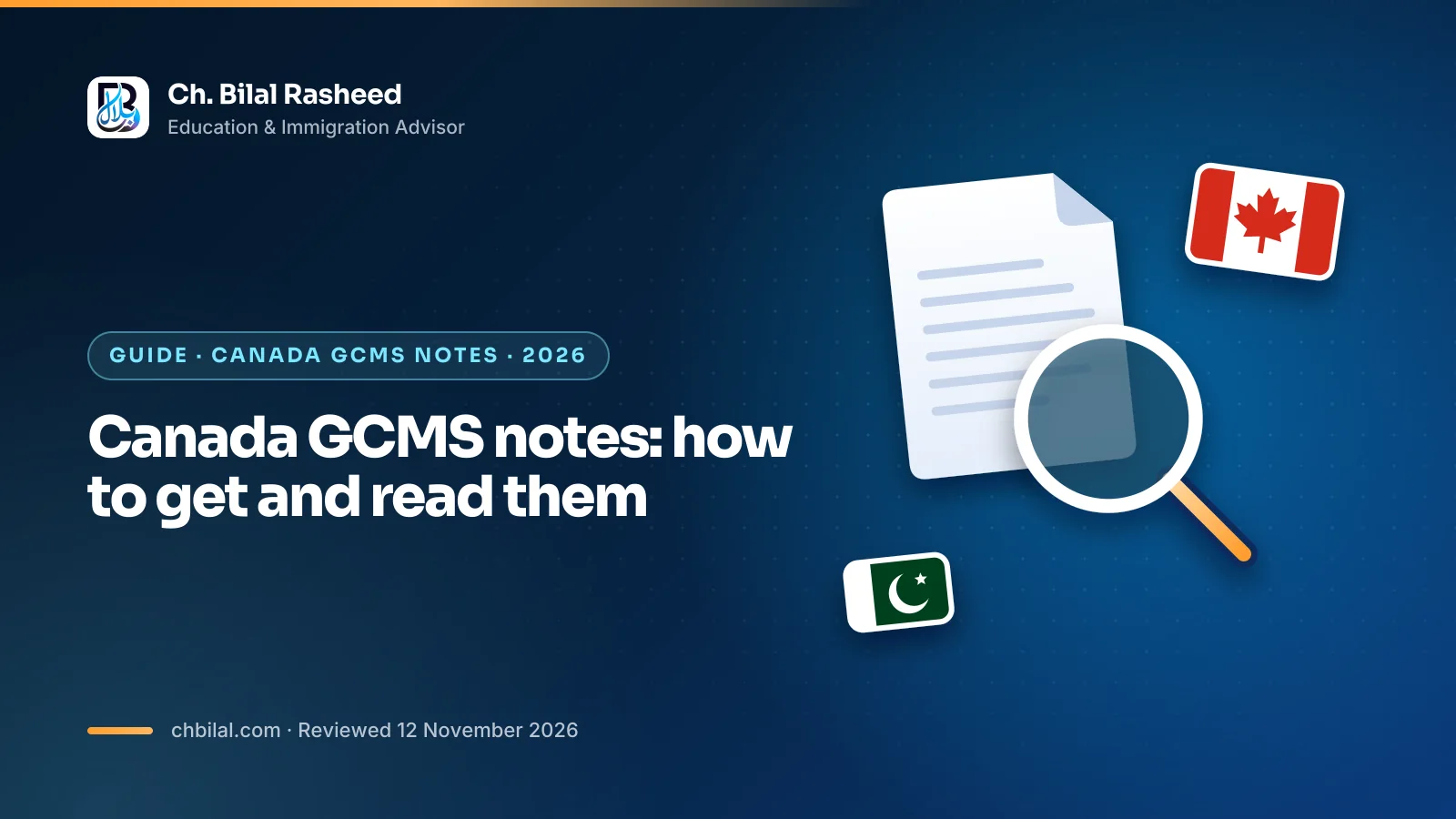
GCMS stands for the Global Case Management System. IRCC’s own privacy impact assessment describes it as a single, integrated system that replaced the older separate systems used by IRCC and the Canada Border Services Agency. Every application you make to IRCC, whether a visitor visa, a study permit or a sponsorship, lives in it.
When people say “GCMS notes”, they mean the copy of that file you receive after a formal request. It usually includes the application details as IRCC recorded them, the dates the file moved, and the officer’s notes on how the application was assessed. That last part is the one refused applicants want.
Why the refusal letter alone is often not enough
A Canadian refusal letter for a visitor visa or study permit usually names the grounds briefly, for example that the officer was not satisfied you would leave Canada at the end of your stay, or that your financial situation did not support the trip. IRCC’s help centre says the letter lists the reasons. What it rarely tells you is which document led the officer there.
The notes often do. An officer may write that the bank statement showed a large deposit shortly before the application, that the purpose of travel was not clear, or that the study plan did not fit the applicant’s earlier education. That is the difference between knowing you were refused on funds and knowing which part of your funds evidence failed.
Who this guide is for
Mainly Pakistani applicants refused a Canadian visitor visa, super visa or study permit, and families helping them. If you are still preparing your first application, the Canada visitor visa guide and the guide to studying in Canada from Pakistan are the better starting points.
Do you still need GCMS notes now that IRCC sends officer decision notes?
Often not, at least not straight away. IRCC changed its practice in 2025, and many refused applicants now receive the officer’s reasons with the refusal itself.
What IRCC’s page says
As of 18 November 2026, IRCC’s page “Explaining application refusals: Officer decision notes” says that since 29 July 2025 it has included officer decision notes with refusals of temporary resident visas (visitor visas, super visas and transit visas), visitor records, study permits and work permits, including extensions. Electronic travel authorisations and temporary resident permits are not covered.
The same page says officer decision notes have been sent with permanent residence refusals since 26 May 2026, except for humanitarian and compassionate applications. That matters for families in a sponsorship, though most Pakistani readers of this guide will be dealing with temporary residence.
| Application type | Notes sent with refusal? | Since |
|---|---|---|
| Visitor visa, super visa, transit visa | Yes | 29 July 2025 |
| Visitor record (extension in Canada) | Yes | 29 July 2025 |
| Study permit, including extensions | Yes | 29 July 2025 |
| Work permit, including extensions | Yes | 29 July 2025 |
| Electronic travel authorisation (eTA) | No | Not covered |
| Permanent residence (most programmes) | Yes | 26 May 2026 |
| Humanitarian and compassionate applications | No | Not covered |
Why the full file can still be worth requesting
IRCC’s page also says that in some cases it may remove portions of the note. The decision notes are about the decision. The full file can show more, such as what IRCC recorded as received, when each step happened, and any earlier notes on the file. If your decision notes are a few lines long and you still cannot see what went wrong, the full request is the next step.
If your refusal predates 29 July 2025, or you never received notes for another reason, a formal request is still the only way to see the officer’s reasoning.
Should you request under the Privacy Act or the Access to Information Act?
For a Pakistani applicant outside Canada asking for their own file, the Privacy Act. It is free and open to you wherever you live. The Access to Information Act route is narrower than many agents suggest.
The Privacy Act route
As of 18 November 2026, IRCC’s page on how to make a request under the Privacy Act says Canadian citizens, permanent residents and foreign nationals, regardless of where they are located, can ask for their own personal information. It also says there are no fees involved. A refused applicant in Lahore or Karachi can therefore make the request directly.
The Privacy Act gives you your own personal information. If the file also holds information about another person, such as a sponsor or a family member, that person’s details may be withheld unless they have consented.
The Access to Information Act route
Section 4 of the Access to Information Act, as extended by the Access to Information Act Extension Order No. 1, gives the right of access to Canadian citizens, permanent residents, and individuals and corporations present in Canada. IRCC’s own page on access to information requests repeats that limit. Someone in Pakistan cannot use this route themselves.
This is why you may hear of a relative in Canada, or a Canadian representative, requesting a file on someone’s behalf. In that case IRCC asks for its consent form IMM 5744, signed by each person on the file aged 16 or over. The fee for an access to information request is CAD 5, paid when the request is made.
| Privacy Act | Access to Information Act | |
|---|---|---|
| Who can ask | Citizens, PRs and foreign nationals anywhere, for their own information | Citizens, PRs and people or companies present in Canada |
| Fee | None | CAD 5 |
| Usable directly from Pakistan? | Yes | No |
| Statutory response time | 30 days | 30 days |
| Extension | Up to 30 more days, longer for translation | A reasonable period in set cases, with notice |
| Consent form for a third party | IMM 5744 | IMM 5744 |
How much do GCMS notes cost, and how long do they take?
The government cost is nil under the Privacy Act and CAD 5 under the Access to Information Act. Both laws set 30 days for a response, with extensions allowed.
The fee
Section 7 of the Access to Information Regulations sets the CAD 5 application fee for an access request. IRCC’s Privacy Act page says there are no fees for a request under that law. There is no official “fast track” for a fee. A service that promises notes in a few days for a premium cannot change the department’s processing.
The timeline
Section 14 of the Privacy Act requires a response within 30 days. Section 15 allows an extension of up to 30 more days, or a reasonable period where translation is needed. Under the Access to Information Act, section 7 sets 30 days, and section 9 allows an extension for a reasonable period where the request is large, needs consultation, or involves third parties, with notice to you within the first 30 days.
IRCC’s request pages say that high request volumes may affect its ability to meet these timelines. Plan as if the notes may take longer than a month, and do not let that wait run down a judicial review deadline.
How do you read GCMS notes?
Slowly, and against the refusal letter. The notes are written for other officers, not for you, so they are short, full of abbreviations and sometimes blunt. The skill is matching each line to a reason and a document.
Find the decision entry
The file often runs to many pages of system data. The part that matters most is usually the officer’s assessment near the decision date. Start there, then read backwards to see what was on file when the officer decided.
Separate what the officer saw from what they concluded
A note such as “PA’s bank statement shows large deposit, source not explained” contains a fact and a gap. The fact is the deposit. The gap is the missing explanation. A new application answers gaps with documents. It does not argue with facts the officer read correctly.
Common abbreviations
IRCC does not publish an official glossary for applicants, so treat any list as a reading aid rather than a definition. In practice you will often see PA for principal applicant, TRV for temporary resident visa, SP for study permit, LOA for letter of acceptance, POF for proof of funds and DLI for designated learning institution. If a term in your notes is unclear, ask about it rather than guessing what it means.
Look for what is missing
Officers often record what they looked for and did not find: no employment evidence, no explanation of a study gap, no evidence of the host’s status in Canada. These lines are the easiest to fix, because the remedy is a document you can obtain.
Which refusal reasons do the notes usually explain, and what rule sits behind them?
For a visitor visa, the core rule is section 179 of the Immigration and Refugee Protection Regulations. It says an officer shall issue a temporary resident visa if, following an examination, it is established that the applicant meets the listed conditions, including that they will leave Canada by the end of the period authorised for their stay. Most visitor refusal reasons are a version of that test.
IRCC’s visitor visa eligibility page names the factors behind it in plain words: ties such as a job, home, financial assets or family that will take you back, enough money for the stay, and an intention to leave. The notes usually say which of those the officer was not satisfied about, and why.
| Reason in the letter | What the notes often say | What a new file needs |
|---|---|---|
| Not satisfied you will leave at the end of your stay | Purpose unclear, length of stay out of proportion, weak evidence of job or family in Pakistan | A specific purpose, a realistic stay, employer leave letter, property or business records |
| Financial situation does not support the trip | Funds insufficient for the stated plan, recent unexplained deposits, income not shown | Statements over a longer period, salary or business income records, a source for any large credit |
| Purpose of visit not consistent with a temporary stay | Invitation vague, host status not shown, study plan does not follow earlier education | Host’s status and letter with dates, or a study plan that explains the choice of course |
| Travel history | Limited travel outside Pakistan noted alongside other concerns | Nothing to fabricate; strengthen the other factors and declare history accurately |
Travel history deserves a word. An officer may note limited travel, but that is usually one factor among several. Do not rush a holiday abroad just to fill a passport. Fix the factors you can evidence.
For study permits, the notes often turn on the study plan, the funds and the link between the course and your background. The guide to what to do after a student visa refusal and the statement of purpose guide go through those parts of a file.
What can you do after reading the notes?
IRCC gives two routes for a temporary residence refusal: a new application, or judicial review in the Federal Court. There is no internal appeal.
No formal appeal
As of 18 November 2026, IRCC’s help centre says there is no formal process to appeal decisions on temporary residence applications. It says to apply again only if your circumstances have changed or you have new information, and otherwise names the Federal Court as the route to challenge the decision.
A new application
IRCC’s help centre says you can apply again at any time, unless your decision letter says you cannot. It also says reapplying with the same information will likely not change the decision, and that using a representative does not by itself improve your chances. The notes tell you what has to change. The guide to reapplying after a visa refusal covers that discipline across countries.
A new visitor visa application means paying again. As of 18 November 2026, IRCC’s fee list shows CAD 100 per person for a visitor visa, including a super visa, with a family maximum of CAD 500, and CAD 85 per person for biometrics, with a family maximum of CAD 170.
Judicial review
Judicial review asks a Federal Court judge whether the decision was made lawfully and reasonably. It does not re-decide your visa. Under section 72(2)(b) of the Immigration and Refugee Protection Act, the application for leave must be filed within 15 days for a matter arising in Canada and 60 days for a matter arising outside Canada, counted from when you were notified or otherwise became aware of the decision. A judge may extend the time for special reasons.
Rule 23 of the Federal Courts Citizenship, Immigration and Refugee Protection Rules sets a CAD 50 fee to file an application for leave. IRCC’s officer decision notes page adds that, on judicial review, the court can obtain the full reasons for the decision. Whether review is worth pursuing is a question for a Canadian lawyer, and the 60-day clock is the reason to ask early.
If the notes mention misrepresentation
Read this part with care. Section 40(1)(a) of the Immigration and Refugee Protection Act makes a person inadmissible for directly or indirectly misrepresenting or withholding material facts that could induce an error in administering the Act. Under section 40(2)(a), the person stays inadmissible for five years after a final determination made outside Canada. A finding like this is not an ordinary refusal, and a new application cannot simply fix it.
Who can lawfully advise you on a Canadian refusal?
Canada restricts paid advice more tightly than most countries. Section 91 of the Immigration and Refugee Protection Act says no one may knowingly represent or advise a person for consideration in connection with an application, except lawyers and other members in good standing of a Canadian provincial law society, notaries of the Chambre des notaires du Québec, and licensees of the College of Immigration and Citizenship Consultants.
I am an immigration advisor in Pakistan. I am not a CICC licensee or a member of a Canadian law society, so I cannot be paid to advise on or represent you in an IRCC application. What I can give, and what this guide is, is general information about the published rules. If your notes point to judicial review or misrepresentation, speak to an authorised representative.
That rule also protects you. Someone in Pakistan offering to “fix” your Canadian refusal for a fee, with no Canadian licence, is breaking Canadian law. The guide to checking a visa consultant in Pakistan explains how to check a licence before you pay.
How do you request your GCMS notes, step by step?
This order suits most Pakistani applicants refused a visitor visa or study permit from outside Canada.
Read the refusal letter and any officer decision notes first
Since 29 July 2025, IRCC says it sends officer decision notes with refusals of visitor visas, super visas, transit visas, visitor records, study permits and work permits. Check your account and the letter itself before you request anything, because the reasons may already be in your hands.
Choose the right law for the request
A Pakistani applicant outside Canada asking for their own file uses the Privacy Act, which IRCC opens to foreign nationals wherever they are, with no fee. The Access to Information Act route costs CAD 5 and is open only to Canadian citizens, permanent residents and people or companies present in Canada.
Get consent forms where someone else is asking
If a relative in Canada or an authorised representative makes the request for you, IRCC asks for its consent form IMM 5744 from each person on the file aged 16 or over. Sign it with the same name spelling as your passport and the application.
Submit through the Government of Canada request service
Use the official online access to information and privacy request service, or IRCC’s paper form IMM 5563 by mail. Give your full name, date of birth, application number and UCI exactly as they appear on IRCC correspondence, so the file can be found without delay.
Expect 30 days, and allow for an extension
Both laws set a 30-day response time. The Privacy Act allows an extension of up to 30 more days, longer where translation is needed, and the Access to Information Act allows a reasonable extension in some cases. IRCC warns that high volumes can affect its timelines.
Read the notes against the refusal reasons, line by line
Match each reason in the letter to the officer’s note behind it. Write down what the officer said they saw, what they said was missing, and which document they relied on. That list is what a new application, or a lawyer considering judicial review, actually works from.
Decide between a new application and a lawyer’s opinion
IRCC says there is no formal appeal for temporary residence refusals. You can apply again at any time unless the letter says otherwise, or speak to a Canadian lawyer about judicial review, where the leave application must be filed within 60 days for a decision made outside Canada.
What goes wrong most often?
Paying an agent for a free request
The Privacy Act route costs nothing and is open to you from Pakistan. Families still pay sizeable sums for a request that takes a short form and a copy of the refusal letter. If you pay someone, know what you are paying for.
Reapplying before reading the reasons
The pressure of an intake date or a wedding pushes people to reapply within days. IRCC itself says the same information will likely produce the same decision. A second refusal on the same grounds does nothing for the third application.
Letting the judicial review deadline pass
The 60-day period for a decision made outside Canada runs while you wait for notes. If review is a real option, the conversation with a Canadian lawyer has to happen inside that window, not after the notes arrive.
Wrong details on the request
A misspelt name, a missing UCI or the wrong application number slows the search. Copy every identifier from IRCC correspondence exactly.
Reading one line out of context
Applicants fix on a single phrase, often about travel history, and ignore the paragraph about funds above it. Read the full assessment before deciding what failed.
Arguing with the officer in the next application
A cover letter that says the officer was wrong rarely helps. A cover letter that says “the earlier file did not show the source of the deposit; it is now shown in documents 4 to 6” does. Answer the gap with evidence.
A realistic example
This is a hypothetical illustration, not a real client. Hamza, 34, is a pharmacist in Faisalabad. He applied for a Canadian visitor visa to attend his sister’s graduation in Toronto and was refused. The letter said the officer was not satisfied he would leave Canada at the end of his stay, and that his financial situation did not support the trip.
- Reading the decision notes. The refusal came with officer decision notes. They said his bank statement showed a PKR 1,200,000 deposit eleven days before he applied with no explanation, and that the purpose of travel was described only as “family visit”, with no dates or host details.
- Requesting the full file. To see what IRCC recorded as received, he made a free Privacy Act request himself through the official request service, copying his UCI and application number from the refusal letter.
- Fixing the gaps. The deposit came from the sale of a plot. He gathered the sale deed and transfer record, six months of salary statements and a leave letter from his employer for exact dates.
- Rebuilding the purpose. His sister supplied her university’s graduation notice, her own status document in Canada and a letter giving the dates and her address.
- Reapplying. He paid the CAD 100 fee again, declared the earlier refusal, and wrote a short letter listing which documents answered each point in the notes.
No outcome is promised. What changed is that every concern in the notes now has a document against it.
The version that goes wrong
Now imagine Hamza pays PKR 60,000 to a local agent for “GCMS plus reapplication”. The agent submits a new application within a week, using the same bank statement and a stronger-sounding invitation letter written by the agent, not his sister. The notes arrive a month later saying the same thing. By then a second refusal is on his file, and he has paid for a request the government would have handled free.
Key takeaways
- GCMS notes are your IRCC file, including the officer’s notes on why the application was decided as it was.
- Since 29 July 2025, IRCC sends officer decision notes with refusals of visitor visas, super visas, visitor records, study permits and work permits, so read those first.
- From Pakistan, request your own file under the Privacy Act, which is open to foreign nationals anywhere and charges no fee.
- The Access to Information Act route costs CAD 5 and is open only to citizens, permanent residents and people or companies present in Canada.
- Both laws set 30 days to respond, with extensions allowed, and IRCC warns that volumes can slow things down.
- There is no IRCC appeal for temporary residence refusals; the options are a new application or judicial review, filed within 60 days for a decision made outside Canada.
- Only authorised representatives may be paid to advise on a Canadian application, under section 91 of the Immigration and Refugee Protection Act.
Frequently asked questions
What are GCMS notes?
GCMS is the Global Case Management System, the single case management system IRCC uses to process applications. GCMS notes is the everyday name for the record of your file in that system, including the officer’s notes on how your application was assessed and why it was decided as it was. You get them by making a request under Canada’s Privacy Act or Access to Information Act.
Can I request my GCMS notes from Pakistan?
Yes, under the Privacy Act. As of 18 November 2026, IRCC’s page on Privacy Act requests says foreign nationals can ask for their own personal information regardless of where they are located. The Access to Information Act route is narrower: it is open only to Canadian citizens, permanent residents and individuals or corporations present in Canada.
How much does a GCMS notes request cost?
A Privacy Act request for your own file is free; IRCC’s page says there are no fees involved. An Access to Information Act request costs CAD 5, paid when the request is made, under section 7 of the Access to Information Regulations. Anyone charging you a large sum simply to file the request is charging for their own time, not a government fee.
How long do GCMS notes take to arrive?
Both laws set a 30-day response time. Under section 15 of the Privacy Act, the department can extend by up to 30 more days, or longer where translation is needed. Under section 9 of the Access to Information Act, it can extend for a reasonable period in some cases and must tell you. IRCC says high request volumes can affect these timelines.
Do I still need GCMS notes now that IRCC sends officer decision notes?
Sometimes not. As of 18 November 2026, IRCC says it has sent officer decision notes with refusals of temporary resident visas, visitor records, study permits and work permits since 29 July 2025, and with most permanent residence refusals since 26 May 2026. Read those first. The full file can still help where notes are short or parts were removed.
Can IRCC remove parts of my notes?
Yes. IRCC’s page on officer decision notes says that in some cases it may remove portions of the note. Requests under the Privacy Act and the Access to Information Act can also come back with parts withheld under the exemptions in those laws. A blank section does not by itself mean anything was hidden about you in particular.
Who can request my notes for me?
Anyone you authorise, such as a relative in Canada or an authorised representative, with IRCC’s consent form IMM 5744 signed by each person on the file aged 16 or over. For the Access to Information Act route, the requester must themselves be a citizen, permanent resident or person present in Canada.
Can I appeal a Canadian visitor visa or study permit refusal?
Not through IRCC. As of 18 November 2026, IRCC’s help centre says there is no formal process to appeal decisions on temporary residence applications. The options it names are applying again if your circumstances have changed or you have new information, or asking the Federal Court to review the decision.
What is the deadline for judicial review of a refusal made outside Canada?
Section 72(2)(b) of the Immigration and Refugee Protection Act sets 60 days for a matter arising outside Canada, and 15 days for one arising in Canada, counted from when you were notified or otherwise became aware of the decision. A judge may extend this for special reasons. The Federal Court’s filing fee for an application for leave is CAD 50.
Should I wait for GCMS notes before reapplying?
If you do not understand why you were refused, usually yes. IRCC says you can apply again at any time unless your letter says otherwise, but also that reapplying with the same information will likely not change the decision. A judicial review clock is running at the same time, so a lawyer’s view should not wait for the notes if you are considering it.
Can GCMS notes show that I was refused for misrepresentation?
Yes, if that was the finding. Section 40 of the Immigration and Refugee Protection Act makes misrepresenting or withholding material facts a ground of inadmissibility, and the person stays inadmissible for five years after the determination. A misrepresentation finding is very different from an ordinary refusal and is a reason to speak to an authorised representative.
Can Ch. Bilal Rasheed help me read my GCMS notes?
Within clear limits. A consultation can be booked in Lahore, on WhatsApp or by phone for a general explanation of what IRCC’s published rules say. He is an immigration advisor in Pakistan, not a CICC licensee or Canadian law society member, and section 91 of the Immigration and Refugee Protection Act lets only authorised representatives be paid to advise on or represent you in an IRCC application.